Why This Matters
A Federal Reserve decision made in Washington can begin changing the financial conditions of a long-term foreign resident in Doha, Dubai or Riyadh almost immediately.
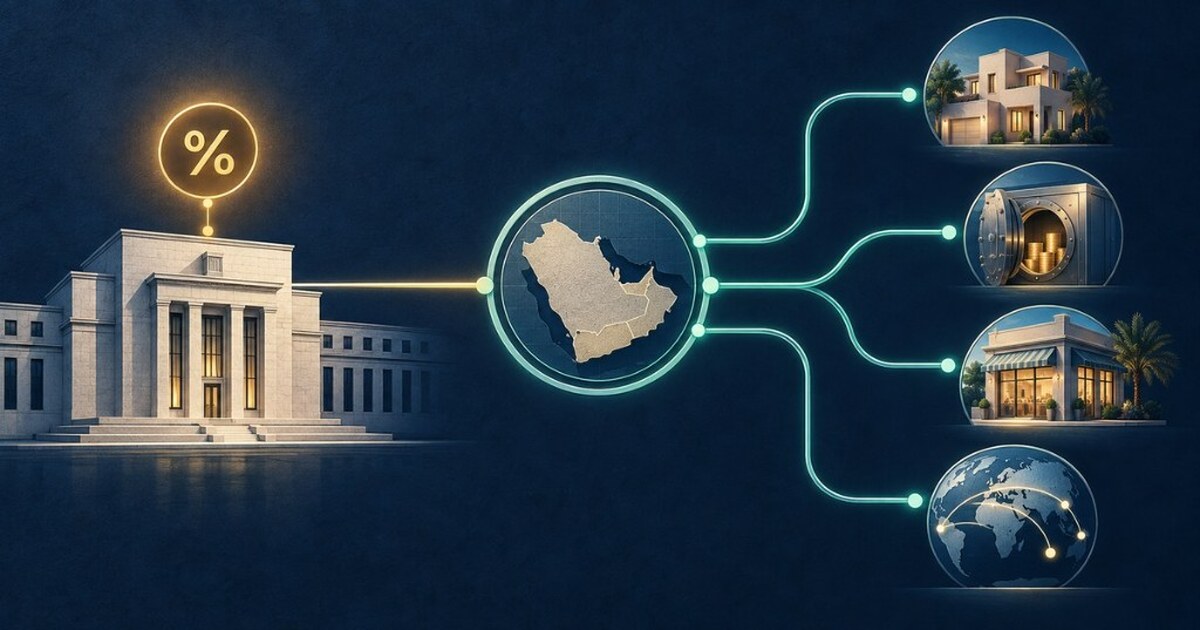
The reason is structural. Most GCC currencies are tied to the US dollar, so regional central banks often move interest rates in the same direction as the Federal Reserve to support currency and monetary stability. After the Federal Reserve raised its policy rate by a quarter point on 16 September 2026, central banks in Saudi Arabia, the UAE, Oman and Qatar raised key rates by 25 basis points. Kuwait, whose currency is linked to a basket rather than only the dollar, follows a somewhat different framework.1
Local banks then reassess deposit returns, new-loan pricing, variable-rate facilities and the cost of business credit. Not every mortgage or personal loan resets on the day of a central-bank announcement. A fixed-rate facility may not change at all during its fixed period, while a variable-rate loan may move only on its contractual reset date. The central-bank decision changes the financial environment quickly; the effect on a specific customer still depends on the contract.
Foreign residents can be particularly exposed because many manage a financial life across two or more countries. They may earn in Qatari riyals, UAE dirhams or Saudi riyals while supporting family abroad, saving for a home elsewhere, paying education costs in another currency or planning retirement outside the Gulf. A rate increase can therefore affect more than a local monthly payment. It can change the return on cash, the cost of refinancing, the timing of a property purchase and the value of money eventually converted into another currency.
The impact is uneven. A resident with variable-rate debt may face higher repayments, while a saver renewing a fixed deposit may receive a better quoted return. Someone preparing to leave the GCC may still find that a higher local rate does not protect purchasing power in the country where the money will eventually be spent.
The useful question is not whether GCC rates are rising. It is where the rate change enters a cross-border financial structure first.
Key Points
- Most GCC central banks tend to move in the same direction as the Federal Reserve because their currencies are linked to the US dollar.
- A policy-rate increase does not mean every mortgage, personal loan or deposit rate rises immediately or by the same amount.
- Long-term foreign residents often earn in one currency while saving or spending in another, creating both interest-rate and currency exposure.
- Higher deposit rates can improve nominal income, but inflation, fees, early-withdrawal terms and future currency conversion still determine the real benefit.
- Small businesses can feel the change through working-capital loans, inventory finance, slower customer demand and delayed investment.
- The first task is to identify which part of the household or business balance sheet resets first.
Why Gulf Rates Often Follow the Fed
A currency peg exchanges some monetary-policy independence for exchange-rate stability. Qatar, the UAE, Saudi Arabia and Oman maintain tightly managed links between their currencies and the US dollar. That stability is useful for trade, contracts, budgeting and investor confidence, particularly in economies where energy exports and many international transactions are denominated in dollars.
A peg also creates a constraint. If US and local interest rates move too far apart, money can flow toward the currency offering the more attractive risk-adjusted return. Central banks can use reserves, liquidity tools and regulation to manage pressure, but keeping short-term rates broadly aligned with the dollar helps support the system.
Local liquidity, credit demand and banking competition still matter. The transmission is a strong directional relationship, not a promise of identical pricing.
Qatar’s framework illustrates the layers involved. Qatar Central Bank publishes separate money-market deposit, lending and repo rates, and uses the average overnight interbank rate as an operating target.2 3 A household does not borrow at the policy rate itself. Banks build customer pricing from their funding costs, risk assessment, product structure, collateral, term and competitive conditions.
Where the Change Reaches a Household
Variable-rate debt
The most direct exposure is a loan tied to a benchmark or bank reference rate. The payment may change at the next reset rather than on announcement day. Borrowers should look for four items in the contract: the benchmark, the margin added by the bank, the reset frequency and any cap or floor.
A 25-basis-point policy move is not automatically a 25-basis-point increase in the customer’s rate. It may be more, less or zero, depending on those terms. A borrower who does not know the reset mechanism cannot estimate the cash-flow effect.
New mortgages and refinancing
Even households with fixed-rate debt can be affected when they seek a new mortgage or refinance. Higher funding costs can reduce the amount available for the same monthly payment, weakening purchasing power before the headline property price changes.
Rental demand, population growth and limited supply may still support prices while financed buyers face tighter affordability.
Deposits and cash
Savers may welcome higher deposit offers, but the quoted annual rate is only the start of the comparison. The saver must check the lock-up period, early-withdrawal penalty, minimum balance, renewal terms and whether the rate is fixed for the full tenor.
A resident planning to spend later in euros, pounds, won or another currency does not ultimately consume in QAR, AED or SAR. A higher Gulf deposit return does not remove future exchange-rate risk.
Credit cards and personal finance
Credit-card balances and unsecured loans deserve attention because their pricing can already be high. Check the statement, repayment terms and any change notification rather than assuming every card rate moved with the central bank.
Why Small Businesses May Feel It Twice
For an SME, higher rates can affect both financing costs and customer demand.
The first channel is direct. A business using overdrafts, revolving credit or short-term facilities may pay more for working capital. Inventory becomes more expensive to hold when it is financed. A restaurant, retailer or importer may also face higher supplier and transport costs at the same time.
The second channel arrives through customers. Households facing higher debt payments may delay discretionary purchases, trade down or visit less often. A business can therefore experience a tighter margin even if it has no bank loan of its own.
This combination matters in the present environment because energy and transport shocks are already adding pressure to prices. The IMF has warned that persistent oil-price increases can lift inflation and weaken growth, with the effect varying substantially across Middle Eastern economies.4 Raising rates may help contain broader inflation, but it cannot produce more fuel, food or shipping capacity. The policy addresses the risk that a temporary supply shock spreads into wages, expectations and general pricing.
Business owners should separate three questions:
- Which costs are driven by financing?
- Which are driven by supply and logistics?
- Which can realistically be passed to customers without damaging demand?
Not every cost increase is an interest-rate problem, and stronger revenue may not protect cash flow when inventory and debt become more expensive to carry.
What Higher Rates Change for Savers and Investors
Higher rates do not make one asset universally better. They change the price of waiting, borrowing and taking risk.
Swipe to compare
| Position | Possible effect of higher rates | What to verify |
|---|---|---|
| Emergency cash | Better deposit income may become available | Access, penalty and inflation |
| Fixed deposit | New offers may improve | Tenor, renewal and early exit |
| Floating-rate loan | Payments may rise at reset | Benchmark, margin and reset date |
| Fixed-rate loan | Near-term payment may stay unchanged | Fixed period and refinancing date |
| Sukuk or bonds | New issues may offer higher yields; existing prices may adjust | Duration, liquidity and maturity |
| Gold | No income; may still serve a diversification role | Real rates, dollar and volatility |
| Equities | Financing and valuations can face pressure | Debt, margins and pricing power |
| Property | Financed affordability may weaken | Mortgage terms, rent and holding period |
Cash and fixed deposits become more competitive when their income rises, but a nominal rate should still be compared with inflation. Sukuk and bonds can offer income, yet longer duration can make market prices more sensitive to rate changes. Equities are not affected uniformly: a heavily indebted company and a cash-rich company with strong pricing power do not face the same conditions.
For property, distinguish price from affordability. A home can remain expensive while becoming harder to finance. Separate expected rent, borrowing cost, maintenance, vacancy risk and the currency of eventual sale proceeds.
A Five-Question GCC Rate Check
Before making a portfolio change, trace the rate decision through your own structure.
- Which liabilities can reset? List mortgages, personal loans, cards, overdrafts and business facilities, along with their next reset dates.
- How much liquidity must remain immediately available? Do not lock emergency money merely to capture a higher deposit rate.
- What is the real return? Compare deposit or fixed-income income with inflation, fees and tax obligations that may apply in another jurisdiction.
- Which currency will fund the future expense? Match savings to the currency and timing of education, property, family support or retirement where practical.
- What happens if rates stay high for another year? Test the household or business cash flow without assuming an early reversal.
This is a resilience exercise, not a rate forecast. The aim is to identify the first weak point before it becomes an urgent problem.
Takeaways
The GCC’s dollar-linked monetary system provides a valuable form of exchange-rate stability. The cost is that US monetary conditions can enter local financial life even when a household or business has no direct connection to the United States.
That influence is neither instant nor identical for everyone. A variable-rate borrower, a depositor, a cash property buyer and an inventory-heavy SME experience the same policy decision through different channels and at different speeds.
For long-term foreign residents, there is one more layer: the currency in which today’s savings will eventually be spent. A higher local return can strengthen a plan, but it cannot by itself resolve future currency exposure or a poorly matched debt structure.
The practical response is not to treat higher rates as simply good or bad. Ask which part of the financial structure resets first, what currency the obligation belongs to, and how long cash flow can absorb the change.
This article is for general educational purposes. It does not provide individualized investment, borrowing, tax or legal advice. Product pricing and contract terms vary by bank, jurisdiction and customer profile. Check the current terms of any deposit, loan, Sukuk or investment before making a decision.
Related Analysis
- 5.06% for Five Years: What the UAE’s New Retail T-Sukuk Means for GCC Savers
- How Much Emergency Cash Should an Expat Keep?
- The Cross-Border Money System: A Practical Starting Point for GCC, Middle East and Africa Residents
Sources
- Reuters — Most Gulf bourses end higher as investors weigh Fed rate hike, 17 September 2026.
- Qatar Central Bank — Current Policy Interest Rates, accessed 24 September 2026.
- Qatar Central Bank — Monetary Policy Tools, accessed 24 September 2026.
- IMF — April 2026 Regional Economic Outlook Update: Middle East and Central Asia, April 2026.

