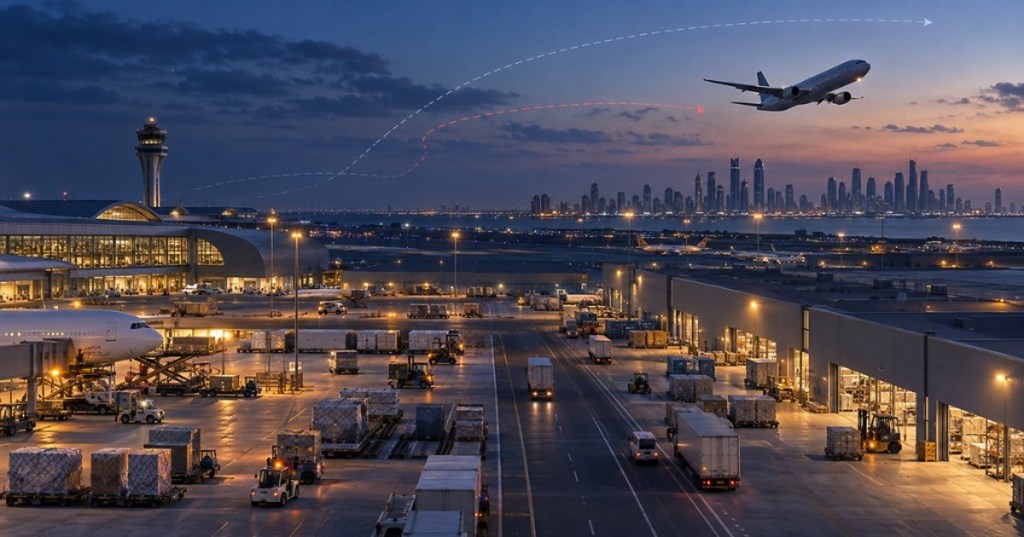
Flight cancellations are the visible problem. The larger economic risk lies in rerouted cargo, delayed inventory, higher business costs and the possibility of a longer-term restructuring of trade and production.
Why This Matters
A cancelled Gulf flight is easy to see. The replacement ticket, hotel bill or missed connection appears immediately. The larger cost is harder to spot.
Gulf hubs connect passengers and time-sensitive cargo moving between Asia, Europe, Africa and the Middle East. When aircraft are delayed or rerouted, perishable goods arrive later, urgent shipments cost more and companies carry more inventory.
If the disruption is brief, much of the damage may also be temporary. Repeated interruptions are different. They can push companies to diversify routes, hold larger inventories or move selected production closer to customers. Governments may respond by supporting strategic industries and transport infrastructure. Those decisions can strengthen resilience, but they can also raise costs and inflation pressure before new supply becomes available.
The important question is therefore not only when flights will return to normal. It is whether repeated disruption changes how goods are produced, stored and moved.
Key Points
- Flight cancellations are only the visible edge of aviation disruption.
- Rerouting can increase flight time, fuel use, crew requirements and scheduling complexity.
- Air cargo carries less than 1% of world trade by volume but more than one-third by value, making disruption especially important for urgent and high-value goods [3].
- Households can feel the effects through replacement travel, delayed goods, delivery charges and higher prices—not only through airfares.
- Businesses may respond by holding more inventory, changing suppliers or accepting higher transport costs.
- Repeated disruption could accelerate supply-chain diversification and selective regional production. Full relocalisation, however, can be costly and does not automatically improve resilience [4].
- Public investment in strategic capacity is not automatically inflationary. The result depends on how quickly spending becomes productive supply.
The Flight Board Is Only the First Layer
On 23 September 2026, passengers using airports in Dubai, Abu Dhabi and Sharjah faced a mixture of cancellations and long delays. Reported disruption affected routes involving India, Iran, Oman and other regional and international destinations [1]. The details were specific to particular flights and could change quickly; this was not a shutdown of Gulf aviation.
The broader operating environment nevertheless remained unsettled. The European Union Aviation Safety Agency listed an active advisory for the airspace of the Persian Gulf and Gulf of Oman, revised on 31 August and valid through 30 September 2026 [2]. An advisory is not the same as a closure. It does, however, show why airlines may need additional risk assessment, contingency planning or route changes.
For a passenger, the flight board turns red. For the economy, a delayed aircraft can also mean cargo that misses its connection, a displaced crew or an aircraft that is no longer positioned for tomorrow’s schedule.
That is how a local interruption begins to create costs elsewhere.
The Cost to Travellers and Families
The ticket price is only one part of the cost of a failed journey.
A family may need a replacement booking, another hotel night, meals or ground transport. A missed connection can also disrupt school dates, medical appointments or family care. Refunds may eventually arrive, but the household can still carry two travel charges while it waits.
The less visible loss is time: extra leave, missed paid work or a business traveller arriving after the meeting that justified the trip. Insurance may cover some losses, but reimbursement is not the same as avoiding the cost.
This creates a better household question than “How expensive was the airfare?”
What is the total cost if the journey does not work as planned?
That total includes money, time and the value of lost options.
Why Air Cargo Matters More Than Its Weight Suggests
Most goods do not travel by air. IATA says airlines carry less than 1% of global trade by volume. Yet those shipments represent more than 33% of global trade by value—about USD 8.3 trillion a year [3].
Air freight is disproportionately used when a product is valuable, perishable, urgent or expensive to leave idle. Examples include pharmaceuticals, electronic components, machinery parts and fresh food, although the cargo mix differs by route.
A low-value bulk shipment can often wait or move by sea. A missing component that stops a production line creates a different calculation: its economic cost may be many times the freight charge.
The transmission path can be remembered in five steps:
- Delay — a flight, shipment or connection fails to move as scheduled.
- Detour — the airline or shipper changes the route, timing or transport mode.
- Inventory — the importer holds more stock to reduce the risk of running out.
- Price — extra transport, storage and financing costs compress margins or reach customers.
- Redesign — repeated disruption changes suppliers, logistics networks or production locations.
Not every delay completes this chain. Duration and repetition matter.
What Happens Inside a Business
Consider an importer that normally receives a time-sensitive product twice a week. When delivery becomes less predictable, it has several choices. It can accept the risk of empty shelves, pay for a faster alternative route, or hold more inventory.
More inventory requires warehouse space and working capital. Alternative routes may add handling, customs procedures and insurance. A supplier change can require new contracts, quality checks and minimum orders. Products with short shelf lives may be lost before sale.
Large businesses may negotiate priority capacity or spread orders across suppliers. Smaller firms often have less bargaining power and cash, so they may pay more for smaller shipments.
Who pays depends on competition and duration. A business may first accept a lower margin. If costs persist and competitors face the same pressure, price increases become more likely. Some products may disappear temporarily or be replaced with cheaper alternatives.
The result is not one universal price increase. It is a series of decisions about margins, availability, quality and timing.
When a Temporary Disruption Becomes a Trade Strategy
One week of delays rarely causes a country to rebuild its production base. A repeated pattern can change the calculation.
Importers may diversify suppliers. Freight companies may develop alternative hubs. Manufacturers may keep critical components closer to production. Governments may invest in warehouses, customs systems, transport links or selected domestic industries.
This does not mean that imports and exports collapse. Reliability usually weakens first. Urgent shipments use costlier routes, low-margin transactions stop making sense, and firms favour dependable suppliers even at a higher quoted price.
If instability persists, companies may move selected activities nearer to customers while governments promote regional production of strategically important goods.
But “make everything at home” is not a free resilience strategy. OECD modelling indicates that broad supply-chain relocalisation could reduce global trade by more than 18% and global real GDP by more than 5%, without consistently making economies more stable [4]. The figures are modelled scenarios, not forecasts for the current Gulf disruption. Their value is the warning they provide: replacing international efficiency with domestic duplication can be expensive.
A more credible response is usually a mix:
- diversified suppliers;
- strategic inventory;
- alternative transport corridors;
- selective regional production; and
- faster, more interoperable customs and logistics systems.
Resilience comes from having workable options, not simply from drawing a national border around every supply chain.
Would Strategic Production Create More Inflation?
This is where a logistics story becomes a money story.
Factories, warehouses and transport corridors require land, labour, materials and finance. If incentives raise demand faster than the economy can supply those resources, prices can come under pressure.
Public support is not identical to printing money, and strategic investment is not automatically inflationary. Productive projects can ease supply constraints later; poorly targeted subsidies may raise demand without durable supply. Financing, exchange rates and monetary policy also matter.
The timing matters most:
Construction and subsidies increase demand before capacity is ready
Possible price effect: Higher labour, land, material and service costs
Regional production remains small or inefficient
Possible price effect: Persistently higher unit costs
New capacity improves productivity and competition
Possible price effect: Greater supply stability and lower long-run pressure
Transport and energy costs remain elevated
Possible price effect: Broader cost pressure on goods and services
Firms and workers expect inflation to persist
Possible price effect: Higher prices and wages can reinforce one another
The IMF has warned that persistent energy and food costs can feed into manufactured goods, services and inflation expectations, with effects differing across Asia, Europe, Latin America, Africa and the Middle East [5]. Aviation is only one part of that transmission. It becomes more important when it combines with expensive energy, constrained shipping and weaker currencies.
The careful conclusion is not that flight cancellations will cause sustained inflation. It is that repeated transport disruption can add to an existing chain of costs—and can influence investment decisions that carry their own short- and long-term price effects.
How to Tell Whether the Change Is Temporary or Structural
One dramatic day is not enough. Watch behaviour rather than headlines.
Signs of a temporary interruption include routes returning quickly, freight capacity normalising and companies running down the extra inventory they accumulated.
Structural change looks different. Airlines keep altered routes. Insurers maintain higher premiums. Importers add suppliers. Warehouses and strategic reserves expand. Governments announce multi-year logistics or industrial programmes.
The most useful indicator is not whether disruption occurred. It is whether companies and governments keep paying to avoid the same vulnerability after the immediate event has passed.
Takeaways
Gulf flight disruption should not be viewed only as a travel inconvenience. Aviation is part of the region’s trade, employment and inventory infrastructure. When that infrastructure becomes less predictable, costs can move from airline schedules into business balance sheets and, eventually, household prices.
A short disruption may produce temporary expenses. Repeated disruption can produce something larger: more inventory, new transport routes, diversified suppliers and selective investment in regional production.
That transition can make economies more resilient, but it is not automatically cheaper. Building factories, warehouses and alternative transport networks requires capital. If spending and demand rise before productive capacity is ready, inflation pressure may persist. If investment raises supply, competition and productivity, the longer-term result may be greater stability.
The question for households, business owners and investors is therefore broader than whether airfares rise next week. It is whether the region is entering a period in which resilience carries a lasting cost—and which businesses, currencies and assets are positioned for that change.
Questions worth considering:
- Which goods and critical components depend on air freight or a small number of routes?
- If businesses hold more inventory, who finances it and who ultimately bears the cost?
- Are policymakers diversifying supply or trying to replace international trade entirely?
- Will new public spending create productive capacity, or mainly increase near-term demand?
- What evidence would show that a temporary logistics shock has become a structural price change?
Educational note: This article provides general economic and financial education. It does not provide individualized investment, legal, insurance or travel advice.
Related Content
- When Hormuz Disrupts Oil: How Inflation Travels Across the World—and Into Your Money
- The Cross-Border Money System: A Practical Starting Point for GCC, Middle East and Africa Residents
Sources
- [1] Gulf News — UAE travellers face flight delays and some cancellations, updated 23 September 2026.
- [2] European Union Aviation Safety Agency — Conflict Zones Advisories, accessed 23 September 2026.
- [3] International Air Transport Association — Cargo: Enabling global trade, accessed 23 September 2026.
- [4] OECD — OECD Supply Chain Resilience Review: Navigating Risks, 2 June 2025.
- [5] International Monetary Fund — How the War in the Middle East Is Affecting Energy, Trade, and Finance, 30 March 2026.

