Byline: Cross Border Money Lab Editorial Team
The reader problem
You can hold a GCC employment contract, pay rent in riyals or dirhams, support relatives in another country, and still keep long-term savings somewhere else — and none of those pots talk to each other. Most “personal finance” checklists assume one tax home, one current account, and a retirement account with a domestic regulator. That is not how money actually moves for globally mobile professionals, families, entrepreneurs, and investors across the GCC, the wider Middle East, and Africa.
The first decision is not which app to download. It is which operating system the household will run so later choices — cash buffers, transfer rails, multi-currency accounts, conversion timing — have a place to live.
Short answer
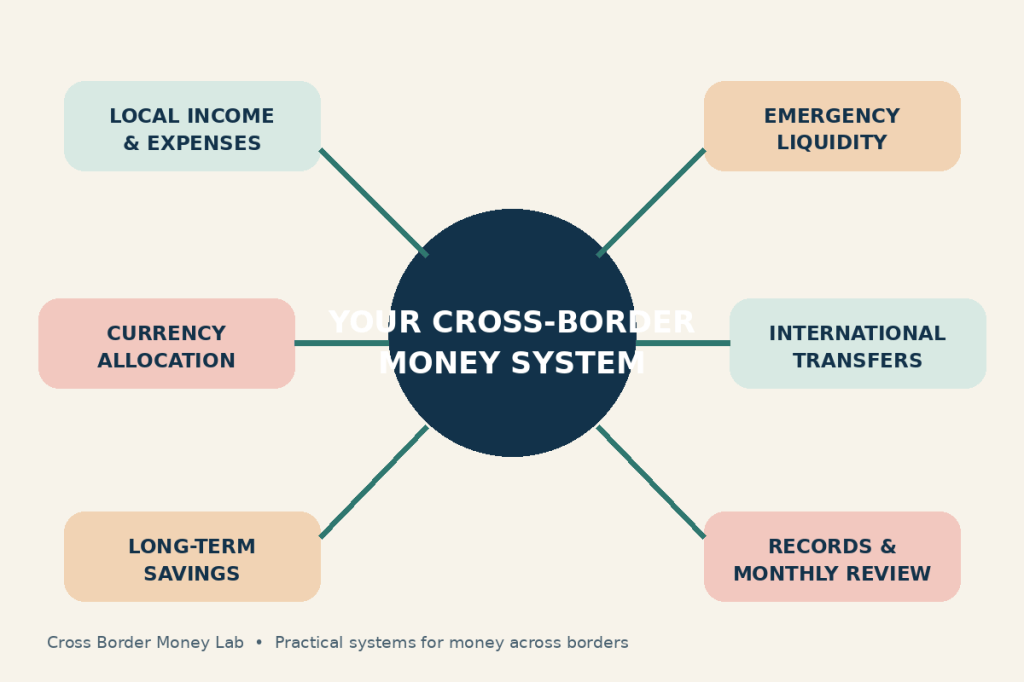
Build seven working parts before you shop for products: local income and expenses, emergency liquidity, currency allocation, international transfers, long-term savings, financial records, and a monthly review. Treat each part as a job with an owner, a location, and a document trail. The framework below is editorial. It is not a regulated product, not a licensed advisory service, and not a substitute for the labour, immigration, or banking rules of the country where you reside.
Why generic advice fails in this region
A US- or UK-shaped plan quietly assumes:
- Employment and the right to remain in the country can diverge for years.
- Take-home pay, housing, schooling, and medical cover are separable line items you choose independently.
- Sending money abroad is an occasional “gift,” not a dated obligation.
- The local currency floats against the dollar in a way that makes “hold local cash vs hold dollars” a speculative question.
In the GCC, residency is commonly tied to work. UAE labour law, for example, sets a written notice band of 30 to 90 days and requires remaining wages and other entitlements to be paid within 14 days after a contract ends (Federal Decree-Law No. 33 of 2021, Articles 43 and 53; MOHRE official text, accessed 21 September 2026). That does not tell you how large a cash buffer to keep — it tells you that job risk and location risk arrive together, which a generic emergency-fund slogan ignores.
On the currency side, some hosting-country units are policy-pegged to the US dollar. Qatar Central Bank states a hard peg of QR 3.64 per US dollar, authorised by Amiri Decree No. 34 of 2001. The Central Bank of the UAE describes automatic intervention at USD/AED 3.672 (buying dollars) and 3.673 (selling dollars). Those are facts about the hosting currency vs the dollar, not facts about the Egyptian pound, Kenyan shilling, naira, cedi, or rand. A Western checklist that says “diversify currency because your salary currency floats” is answering a different country.
Remittance is a system part, not a sidebar. The World Bank’s Remittance Prices Worldwide (RPW) Issue 54 (Q3 2025 data, report dated September 2025) puts the global average total cost of sending USD 200 at 6.36 percent of the amount sent — and that official total is only fee plus exchange-rate margin. Households still face correspondent charges, receiving-side fees, and delay. Those extras belong in the operating system, not in a once-a-year “hack.”
Decision framework: seven parts, in order
Work through the parts in this sequence. Skipping to products is how households collect unused wallets.
1. Local income and expenses
List every inflow: salary, allowances, business drawings, rental income, family transfers in. For each, record currency, country of payment, pay date, and which account actually receives it.
GCC packages often split “basic” from housing, schooling, and tickets. You do not need the full comparison worksheet yet. You do need to know which slice is cash-in-hand this month. If an allowance is paid as a school invoice to a third party, it is not liquidity.
Then separate monthly operating costs in the hosting country (rent cycle, food, transport, utilities, local phone) from lumpy annual costs (tickets, visa medicals, deposits, school invoices). Put the lumpy list on a 12-month calendar. A budget that only looks at the last salary credit will understate Gulf households every quarter.
2. Emergency liquidity
This is cash and near-cash you can reach without a receiving-country bank being open, without a new KYC file, and without waiting for end-of-service settlement. Size it with a risk list, not a copied month-count. The companion article on emergency cash walks through employment stability, visa dependency, family size, insurance, school commitments, relocation or repatriation cost, currency access, and support networks. The system rule here is simpler: name the account and the country where that liquidity sits.
3. Currency allocation
Write which currency each job uses: hosting-country bills, origin-country bills, and any USD (or other) balance you hold because a rail or a contract pays or charges that unit. Qatar’s riyal and the UAE dirham are policy-linked to the US dollar (QCB: QR 3.64 per USD; CBUAE intervention 3.672/3.673). That fact tells you hosting-currency versus USD is usually a policy rate plus a customer margin, not a speculative pair. It does not tell you what the Egyptian pound or Kenyan shilling will do. Allocation is a map of jobs, not a trade.
4. International transfers
For each dated support or investment transfer, record corridor (from/to), rail (bank, exchange house, operator), payout method, and the latest all-in cost you actually observed. In the UAE, licensed institutions must show fees and buy/sell rates, and should try to show correspondent charges, before you confirm a transfer (CBUAE Consumer Protection Standards, section 2.1.5, N 1158/2021). Use that disclosure. Do not store a screenshot of a marketing rate as if it were the cost.
5. Long-term savings
Park here only money that can survive a job change, a visa change, and a delayed transfer. End-of-service entitlements, property, and origin-country investments each have their own legal boxes; they are not “the same as cash.” The system’s job is to stop long-term pots being raided because remittance or rent was never scheduled.
6. Financial records
Keep, in one folder (paper or encrypted drive): contracts, salary slips, tenancy, visa/ID copies, insurance schedules, transfer receipts, and a one-page map of accounts. CBUAE-licensed remittance receipts must carry rate, fees, and routing information where the standards apply. Those receipts are how you reconstruct a dispute. They are also how you notice that a “free” send still moved the exchange rate against you.
7. Monthly review rhythm
Run the same short sequence every month (checklist below). The point is repetition, not sophistication.
Regional comparison: what changes by where you sit
Mobile-readable comparison — three columns:
| If you are based in | Currency vs USD (sourced) | System implication |
|---|---|---|
| Qatar | QCB: QR 3.64 per USD hard peg | Hosting-currency vs USD is a policy rate, not a trade. Other currencies still move via the dollar. |
| UAE | CBUAE: intervenes at 3.672 / 3.673 | Same logic for dirhams vs USD. Retail buy/sell still includes a customer margin. |
| A receiving household in a non-pegged African market | Do not assume a USD peg. Kenya’s central bank describes a market-determined shilling; Egypt’s CBE sets the FX system under Law 194/2020; South Africa’s SARB runs inflation targeting rather than an exchange-rate target. Nigeria and Ghana need their own current circulars before you label the regime. | Origin-side liquidity and payout-rail reliability belong in parts 3 and 4, not in a hosting-country current account alone. |
GCC-to-GCC moves reset tenancy, IDs, and often insurance even when both currencies are dollar-linked. That switching cost is a later article; the system implication now is: do not treat the GCC as one bank account.
Worked example (illustrative)
Label: example, not a typical household.
A single professional in Doha is paid in QAR, sends a monthly amount to a parent in Kenya, and hopes to keep some savings in USD.
| Part | What they write down | Failure mode if skipped |
|---|---|---|
| Local income and expenses | Basic wage date; housing paid to landlord by employer; leftover food/transport | They treat the housing line as spendable cash |
| Emergency liquidity | QAR in a local bank plus a small USD balance they can reach from Qatar | All surplus is already on the way to Nairobi |
| Currency allocation | QAR for Doha bills; KES-need listed as a transfer, not as “USD savings” | They wait on USD/QAR, which QCB holds at 3.64 |
| International transfers | One named rail, receipt stored, cost recorded as fee + rate that month | They compare only the advertised fee |
| Long-term savings | A residual after remittance — not the Kenya send | The send is funded by skipping the buffer |
| Financial records | Contract + last three receipts | A delayed payout cannot be reconstructed |
| Monthly review | First Saturday: balances, next send date, visa expiry | Visa medical is noticed after it is urgent |
No product is “the system.” The system is the map.
Risks and exceptions
When this does not apply
- You are a citizen in a single country, with no cross-border dependents, no foreign-currency obligations, and no plan to move. A domestic budget may be enough.
- You are in a dispute over unpaid wages or a blocked transfer. Use the labour ministry, bank complaint process, or police/cybercrime channel — not this checklist.
- You need regulated advice on tax residency, inheritance, or investment products. This publication does not provide it.
- Your receiving country has published transfer limits or FX rationing. Preparation for those rules is a later, source-heavy article. Do not improvise workarounds from a blog.
Common mistakes
- Collecting five multi-currency apps before listing dated obligations.
- Treating end-of-service as cash.
- Storing all liquidity in the origin country because “home is safer,” then discovering a transfer takes longer than a visa gap.
- Using last month’s transfer screenshot as this month’s cost.
One-page monthly checklist
Print or copy this. It is the operating artefact of the article.
Week 1 of the calendar month
- Record every inflow actually received (amount, currency, account).
- Pay or schedule hosting-country operating costs that fall this month.
- Confirm next 90 days of lumpy costs (visa, school, tickets, deposits).
- Check emergency liquidity: hosting-country near-cash and origin-accessible cash, separately.
- If a remittance is due, collect a fresh quote: fee, rate, payout method, estimated time. Keep the receipt.
- Do not move long-term savings to patch a remittance you failed to schedule.
- Update the account map if any IBAN, wallet, or signatory changed.
- Note visa/ID expiry and insurance end dates.
- Write one sentence: what broke this month (late salary, extra fee, delayed payout).
- Set the next review date.
First 30 days (implementation plan)
This is a start-up sequence, not a second monthly checklist.
Days 1–7. List accounts, currencies, and who can sign. Photograph or export contracts, visa/ID, tenancy, and the last three salary slips into one folder. Write hosting-country essential spend and the next 90 days of lumpy costs.
Days 8–14. Name the emergency-liquidity accounts (hosting country and origin-accessible). Do not move long-term pots yet. Record one dated international transfer you already make: corridor, rail, last receipt.
Days 15–21. Draw the currency-allocation map: which currency pays which bill. If you hold USD in Qatar or the UAE, write why (a job, not a slogan). Compare one fresh transfer quote using fee plus rate, not the homepage adjective.
Days 22–30. Run the monthly checklist once, even if the month is not finished. Book the next review date. Stop opening new wallets until those seven parts have names.
Next Step
Before comparing individual assets or products, map where your emergency, spending and long-term money currently sits—and which country, bank and currency each layer depends on.
Related Content
When the Gulf Feels Less Secure: Gold, Bitcoin and the New Search for Financial Safety — how gold, Bitcoin and cash play different roles after the system is in place.
Upcoming: How Much Emergency Cash Should an Expat Keep?
Upcoming: The True Cost of Sending Money Across Borders
Sources and reviewed date
Reviewed on 21 September 2026.
- UAE Federal Decree-Law No. 33 of 2021, Articles 43 and 53 — MOHRE official text, accessed 21 September 2026.
- Qatar Central Bank Exchange Rate Policy — QR 3.64 per USD hard peg (Amiri Decree No. 34 of 2001); 0.24 percent public USD margin.
- CBUAE Domestic Market Operations — USD/AED intervention 3.672 / 3.673.
- CBUAE Consumer Protection Standards N 1158/2021, section 2.1.5.
- World Bank, Remittance Prices Worldwide, Issue 54 (Q3 2025 / September 2025) — global average total cost 6.36 percent of a USD 200 send.
The seven-part operating system and the first-30-days plan are editorial.
Educational disclaimer
This article is for general education. It is not legal, tax, or investment advice, and Cross Border Money Lab is not a licensed financial adviser. Rules, fees, and product terms change. Check the official source for your country, and a qualified professional where a decision is high-stakes.
 Cross Border Money Lab