Byline: Cross Border Money Lab Editorial Team
The reader problem
The question people type is “how many months.” The decision you actually face, if you live in Doha, Dubai, Riyadh, or another GCC city on an employment-linked visa, is different: how much cash-like money, in which country and which currency, would cover the gap between the last reliable pay cheque and a safe landing — locally, at origin, or both.
A single month-count cannot see visa dependency, school-term fees, or a transfer that does not arrive.
Short answer
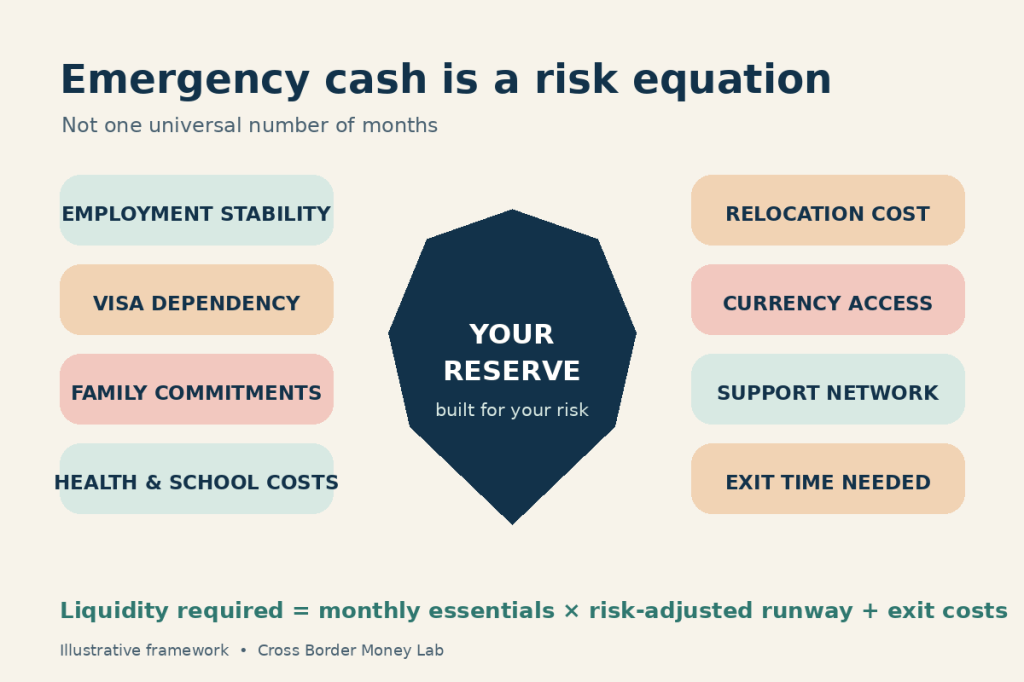
Do not start from three, six, or twelve months as if those were regional rules. They are not. Size a hosting-country near-cash floor from your essential local spend plus named exit costs, then add weeks using an eight-factor risk score. Keep a separate origin-accessible amount equal to origin obligations during the same gap. Notice pay, if you receive it, is not the same as money already in an account you control.
Every number in the worked examples is illustrative. Change the inputs.
Why generic advice fails here
Imported emergency-fund rules assume you can stay in the country while you job-hunt, that the rent contract is the main cliff, and that “home” money is one click away.
GCC labour texts point the other way. In the UAE, either party may end a contract with written notice of not less than 30 and not more than 90 days; the contract continues and the worker is entitled to full wage during that notice if they work (Federal Decree-Law No. 33 of 2021, Article 43). Remaining wages and other entitlements must be paid within 14 days after the contract ends (Article 53). That 14-day window is a legal deadline for the employer, not cash in your pocket on day one, and it does not pay next month’s origin-country rent.
Qatar’s notice rule was rewritten in 2020. An unofficial English translation published by the ILO of Law No. 18 of 2020 (issued 30 August 2020) replaces Article 49: after probation, one month’s notice during the first two years of employment and two months thereafter, with compensation in lieu equal to basic wage for the notice period. The same unofficial text says a foreign worker who leaves without honouring the article shall not be granted a work permit for one year from departure. Limitation: Al Meezan’s English page could not be retrieved in this research window; verify the Arabic/English official text before relying on it in a dispute.
None of those articles prescribe a savings multiple. Using them as a “three-month rule” would be a fabrication.
Transfers add a second clock. World Bank RPW Issue 54 (Q3 2025) notes that bank-to-bank remittances are typically slower than many money-transfer operators, and lists Qatar–Egypt among corridors with no SmaRT-qualifying service that quarter. Origin-side money is not automatically “available this week.”
Decision framework: eight factors, two locations
Step 1 — Essential hosting-country spend
Write one month of cannot-skip local costs: housing you must still pay, food, local transport, communications, medicine. Exclude discretionary travel and exclude amounts an employer already pays to a third party (some housing and school invoices).
Step 2 — Named one-off exit costs
List tickets, deposit recovery delay, visa/medical residual, school-term notice, shipping. If an item is unknown, mark it unknown — do not hide it inside a month-count.
Step 3 — Score the eight factors (0, 1, or 2)
| Factor | 0 | 1 | 2 |
|---|---|---|---|
| Employment stability | Role and paid notice historically reliable | Contract ends this year | Probation, project hire, or unpaid gaps |
| Visa dependency | Independent residency / citizenship | Your visa follows this job | Whole household visa follows this job |
| Family size | One adult | Couple or one dependent | Several dependents, including medically dependent members |
| Health-insurance exposure | Cover continues after exit | Cover ends with the job | Known exclusion you would have to buy |
| School commitments | No school fees or term-notice | One child, term already paid | Unrecoverable term fees or mid-year exit |
| Relocation or repatriation cost | Employer tickets, light deposit, you can remain | Self-funded tickets | Family flights, shipping, forced exit plus origin living-cost shock |
| Currency accessibility | You can move money both ways in days | One slow but working rail | Origin FX friction or unbanked receiver |
| Available support network | Documented local or origin support that can cover 30 days of essentials | Support exists but is delayed or conditional | No one who can legally and practically fund a gap |
Sum = 0 to 16. This scoring is editorial, not a regulator’s formula.
Step 4 — Convert to cash (editorial arithmetic)
- Local near-cash floor = 4 weeks of essential hosting-country spend + the named one-off exit costs.
- Add 1 week of essential spend for every 2 points on the score (round up).
- Origin-accessible cash = origin obligations covering the same gap length. Do not commingle it with local rent money.
A low score can land near five weeks of local essentials plus tickets. A high score can land well above that. Both can be consistent with the method. Neither is a universal right answer.
Step 5 — Split location and currency
Qatar’s riyal and the UAE dirham are policy-linked to the US dollar (QCB: QR 3.64 per USD; CBUAE intervention 3.672/3.673). Holding extra USD in the hosting country is not the same hedge as holding naira or sterling at origin. If the gap is “I must still pay Doha rent next week,” local QAR/AED near-cash is the relevant tool. If the gap is “I must still pay a Nairobi bill if the rail fails,” origin-accessible funds are the relevant tool.
Country comparison (legal clocks, not recommended balances)
| Hosting country | Sourced clock that affects the gap | What it does not tell you |
|---|---|---|
| UAE | Notice 30–90 days (Art. 43); dues within 14 days (Art. 53) | How much you should save; free-zone and domestic-worker rules |
| Qatar | Unofficial EN of 2020 Art. 49: 1 then 2 months’ notice; basic-wage in lieu | Official Al Meezan wording until you confirm it; full-package vs basic |
| Other GCC | Confirm that state’s labour law and your contract | Do not copy UAE/Qatar numbers across the border |
Immigration grace periods after cancellation change and differ by visa class. This article does not invent a 30-day grace figure. Check the interior/immigration authority for your visa, in force on the day you need it.
Worked examples (illustrative)
Example 1 — Single renter, UAE
Assumptions (not statistics): essential local spend AED 8,500 per month; 30-day notice will be worked and paid; after last day, up to 14 days before remaining dues; airfare AED 2,200; housing overlap AED 3,000; residual documents AED 800; no origin obligation this month; eight-factor score = 6 (visa 2, health insurance 1, relocation/repatriation 1, support network 1, others 0–1).
Local floor = 4 weeks of 8,500 (AED 8,500) + 2,200 + 3,000 + 800 = AED 14,500. Score 6 → add 3 weeks (6/2) = 8,500 × 3/4 = AED 6,375. Illustrative local near-cash: AED 20,875. Origin-accessible: 0 in this example.
That is about 2.5 months of this person’s essentials including one-offs — not a rule called “2.5 months.”
Example 2 — Couple, one child in school, Qatar
Assumptions: essential spend QAR 16,000 per month; two years’ service (two-month notice if the unofficial Art. 49 text and the contract agree); school-term friction QAR 8,000; two airfares QAR 4,400; insurance gap QAR 1,500; origin support QAR 2,000 per month that cannot pause; eight-factor score = 13 (employment 1, visa 2, family 2, health insurance 2, school 2, relocation/repatriation 2, currency 1, support network 1).
Local floor = 4 weeks (16,000) + 8,000 + 4,400 + 1,500 = QAR 29,900. Score 13 → add 7 weeks (round 13/2 up) = 16,000 × 7/4 = QAR 28,000. Illustrative local near-cash: QAR 57,900. Origin-accessible for the same gap: treat floor plus add-on as about 11 weeks of origin support → 2,000 × 11/4 = QAR 5,500.
Do not summarise this as “keep six months.” The stack is school + tickets + insurance + score, not a slogan.
Risks and exceptions
When this does not apply
- You have independent residency or citizenship in the hosting country and can remain unemployed without leaving.
- Your employer contractually continues housing and medical cover for a defined period after termination — subtract those lines, do not ignore the contract.
- You already hold liquid assets in the hosting country that you can access without a fire sale. Those count; illiquid land and unvested benefits do not.
- Domestic workers, some free-zone staff, and government employees may sit under different statutes. Use the statute that names you.
Common mistakes
- Counting salary during notice as if it were already in a buffer account.
- Counting end-of-service as emergency cash.
- Keeping everything at origin because a parent can “send it back,” without timing the rail.
- Copying a colleague’s month-count.
Action checklist
- Write essential monthly local spend.
- List one-off exit costs with blanks for unknowns.
- Score the eight factors.
- Compute local floor + score add-on.
- Compute origin-accessible separately.
- Name the accounts (not “somewhere in USD”).
- Re-score when visa status, school enrolment, support, or corridor reliability changes.
- Store labour-contract notice length next to the statutory band.
Related Cross Border Money Lab articles
- The Cross-Border Money System — where this buffer sits in the seven parts.
- Upcoming: The True Cost of Sending Money Across Borders — why origin-side money is not instant.
Sources and reviewed date
Reviewed on 21 September 2026.
- UAE Federal Decree-Law No. 33 of 2021 (as amended), Articles 43 and 53 — MOHRE official PDF.
- Law No. 18 of 2020 amending Qatar Labour Law No. 14 of 2004, Article 49 — ILO unofficial English translation, https://www.ilo.org/media/116216/download (verify on Al Meezan).
- Qatar Central Bank Exchange Rate Policy — QR 3.64 per USD.
- CBUAE Domestic Market Operations — USD/AED 3.672 / 3.673.
- World Bank RPW Issue 54 (Q3 2025) — speed and SmaRT corridor notes.
The eight-factor model and both household workings are editorial examples.
Educational disclaimer
This article is for general education. It is not legal, tax, or investment advice, and Cross Border Money Lab is not a licensed financial adviser. Rules, fees, and product terms change. Check the official source for your country, and a qualified professional where a decision is high-stakes.
 Cross Border Money Lab