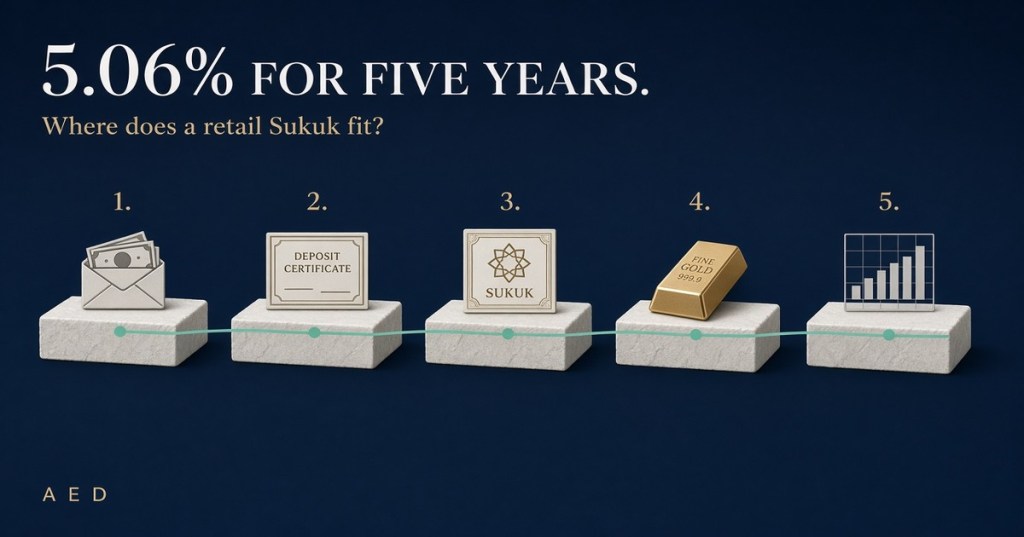
How the new UAE five-year sovereign retail T-Sukuk compares with cash, fixed deposits, gold and growth assets—and what role it may play in a cross-border portfolio.
Why This Matters
GCC savers face an uncomfortable choice. Cash preserves access but may lose purchasing power. Gold can provide diversification but produces no income. Equities offer growth but bring volatility.
The UAE’s new five-year retail T-Sukuk introduces another option: a government-backed, Sharia-compliant instrument offering a stated annual profit rate of 5.06%.
The important question is not simply whether that rate looks attractive. It is what role a five-year asset should play when inflation, interest rates, currency exposure and personal circumstances can all change.
This is therefore not a yes-or-no subscription question. It is an asset-role question.
Key Points
- The new UAE retail T-Sukuk has a five-year tenor and a stated annual profit rate of 5.06%.
- A stated profit rate does not remove maturity, liquidity, market-price, inflation or currency risk.
- Holding to maturity and selling in the secondary market are two different investment decisions.
- Sukuk should be compared with deposits, bonds, gold and equities by role—not by headline return alone.
- The right question is whether the asset strengthens the investor’s overall currency, income and growth structure.
What the UAE launched
This is the second issuance under the UAE Sovereign Retail T-Sukuk Programme. The instrument has a five-year tenor, a stated annual profit rate of 5.06%, and semi-annual profit distributions. The minimum subscription is AED 1,000. The target issuance size is AED 50 million.
According to the Ministry of Finance programme page, the subscription window opens at 08:00 on 23 September 2026 and closes at 14:00 on 28 September 2026 (UAE time). The Emirates News Agency timeline then lists allocation on 29 September 2026, issuance and excess-fund refunds on 30 September 2026, and scheduled Nasdaq Dubai listing and secondary trading on 1 October 2026.
Eligibility is narrower than a GCC-wide offer. The Ministry of Finance states that Retail T-Sukuk investors must hold a valid DFM National Investor Number and be either a UAE national, or a UAE resident holding a valid Emirates ID. Qatar residents, Saudi residents and other internationally mobile readers cannot treat this as an open subscription unless they independently meet those official UAE requirements.
This article is not a subscription tutorial. Application channels, fees and documents are set by the official offering terms and the relevant platform or receiving institution.
Why the second issuance matters
The first issuance under the same programme had a two-year tenor and an annual profit rate of 4.30%, with semi-annual distributions. The initial target was AED 50 million. Subscription orders reached AED 445 million, and the Ministry increased the issuance to AED 100 million. 76% of demand was for AED 10,000 or less, and UAE nationals represented 72% of the investor base. That inaugural sukuk was listed for secondary trading on Nasdaq Dubai on 2 July 2026.
Sovereign fixed-income access in the UAE is moving from an institution-dominated market toward retail participation. The AED 1,000 minimum lowers the cash entry barrier. The five-year tenor creates a longer-duration choice: the investor receives a defined profit stream but faces greater sensitivity to changes in market interest rates, as well as a longer period during which an unexpected need to sell could arise.
Strong demand for the first issuance does not guarantee a favourable secondary-market price or that the second issuance will be upsized again. Oversubscription is a demand fact, not a forecast of future performance.
What a sukuk is, and is not
Sukuk are Sharia-compliant securities. They are structured differently from conventional interest-bearing bonds. The official UAE programme uses an Ijarah/Murabaha structure. Investors receive defined profit distributions under the offering terms. The instrument is sovereign, AED-denominated, and backed by the UAE Government.
“Government-backed” describes the sovereign support and structure presented in the official programme materials. It is not a synonym for “risk-free.” Official communications may describe the programme as a secure or low-risk savings vehicle. Those are programme descriptions, not proof that market price, inflation, liquidity, fees or currency mismatch cannot affect the investor.
A retail T-Sukuk is not a savings account. Access after issuance depends on the secondary market, platform rules and the investor’s time horizon. It is also not identical to a conventional bond, even though duration, reinvestment and early-sale risk rhyme with fixed-income investing. This article does not offer religious or legal interpretation beyond the official documents.
The five asset roles
Cash
Primary role: Immediate access and opportunity reserve
Income or return source: Low deposit return, if any
Main strength: Stability and flexibility
Main risk: Loss of purchasing power
Fixed deposit
Primary role: Defined short- or medium-term saving
Income or return source: Agreed deposit return
Main strength: Predictability
Main risk: Lock-up, reinvestment and inflation risk
Retail T-Sukuk
Primary role: Medium-term income anchor
Income or return source: Semi-annual profit distributions
Main strength: Sovereign-backed AED income
Main risk: Duration, market-price, liquidity and inflation risk
Gold
Primary role: Currency and crisis diversification
Income or return source: Price appreciation only
Main strength: Diversification outside financial income assets
Main risk: Volatility and no recurring income
Global equities
Primary role: Long-term capital growth
Income or return source: Earnings, dividends and price growth
Main strength: Long-run growth potential
Main risk: Significant short-term volatility
The question is not which asset wins. The question is whether each asset has a clearly assigned job.
Cash is for access. A deposit is for a defined, usually shorter, savings period. Gold diversifies and pays no coupon. Equities are a growth engine with drawdowns. A five-year retail T-Sukuk, if it belongs at all, belongs in the gap between money that must stay available and money that can stay invested for a decade or more.
5.06% is a nominal return
5.06% is the stated annual profit rate, not an inflation-adjusted real return. If inflation runs below that rate, purchasing power may increase before fees and other effects. If inflation approaches or exceeds the rate, the real gain narrows or may disappear. This article does not predict UAE inflation and does not promise capital or purchasing-power protection.
Fees, commissions, platform terms and taxes applicable in the investor’s own jurisdiction may affect the result.
Illustrative arithmetic only, before any applicable fees, charges or personal tax obligations. Refer to the final offering terms: AED 10,000 × 5.06% = AED 506 stated annual profit, or approximately AED 253 per semi-annual period. That figure is a teaching example, not a projection and not a recommendation to subscribe.
Holding to maturity is not the same as selling early
The T-Sukuk is expected to be listed and tradable after issuance. Tradable does not mean the market price will always equal the subscription price.
Market interest rates and prices of fixed-rate instruments generally move in opposite directions. If prevailing rates rise, an existing fixed-rate security may become less attractive and its market price may fall. If rates fall, its relative attractiveness and market price may rise. Liquidity and the available bid also matter. A listing can improve the chance of finding a price. It does not freeze that price at par.
An investor who can hold until maturity is making a different decision from an investor who may need to sell in year two or three. The first decision is about the stated profit stream and scheduled repayment under the terms. The second is about accepting whatever the market will pay that day.
The U.S. Securities and Exchange Commission’s investor bulletin makes the same distinction for Treasury bonds: a government guarantee of timely payments is not a guarantee of the resale price if you sell before maturity. Exact rights, risks and repayment provisions sit in the final offering terms.
The currency question
This is an AED-denominated asset. Subscription amounts, profit payments and principal repayments are in dirhams. The UAE dirham is maintained under a fixed peg to the US dollar.
That can make the instrument relevant to people whose future spending or obligations are in AED, or closely linked to USD. It does not eliminate currency mismatch for readers whose future obligations are mainly in EUR, GBP, KRW, INR or another currency.
The relevant question is not only “What does it pay?” but also “In which currency will I eventually use the money?” This article does not forecast the peg, the dollar, or any other exchange rate.
Where it may fit, and where it may not
A five-year retail T-Sukuk may have a role as a medium-term income allocation, as an AED-denominated building block for future spending in the UAE, or as diversification away from an all-cash or all-equity structure—for investors who understand the five-year horizon and the offering terms.
It may be a mismatch for money likely to be needed before maturity; for readers who do not meet UAE eligibility requirements; for investors expecting equity-like capital growth; for investors seeking direct inflation indexation; for investors whose main future liabilities are in a different currency; and for anyone treating “government-backed” as meaning “no possibility of loss under any circumstance.”
None of those lists is a personal recommendation. Suitability depends on liabilities, residency, tax position and time horizon—questions no general article can answer.
Five questions before assigning it a role
- Is there an unfilled space between my immediately available money and my long-term growth assets?
- What would a 5.06% nominal return mean after inflation, fees and my own tax position?
- Does an AED-based asset match the currency of my future spending?
- Could I hold for five years, or might I need to accept a market price by selling early?
- Am I choosing this because it has a defined role—or simply because the headline rate looks attractive?
Conclusion
The new UAE retail T-Sukuk is not automatically a substitute for cash, gold or equities. Its possible value lies in filling a different space: a medium-term, income-producing, dirham-based asset between immediate liquidity and long-term growth.
For GCC investors, the larger lesson is not the headline rate. It is the need to stop treating every asset as if it must perform the same job.
A stronger portfolio begins by separating income, inflation defence, currency exposure and long-term growth—and then deciding which assets deserve each role.
The launch is therefore useful even for readers who cannot—or choose not to—subscribe. It provides a reason to examine whether their current portfolio contains deliberately assigned roles, or merely a collection of assets accumulated at different times.
Educational disclaimer
This article is for general educational purposes only. It does not constitute personal investment, legal, tax or Sharia advice, or a recommendation to subscribe for or trade any security. Eligibility, risks, fees and rights are governed by the official offering documents and the terms of the relevant platform or financial institution.
Related Cross Border Money Lab articles
- When Hormuz Disrupts Oil: How Inflation Travels Across the World—and Into Your Money — how an energy shock can travel into inflation, currencies and the roles inside an asset strategy.
- When the Gulf Feels Less Secure: Gold, Bitcoin and the New Search for Financial Safety — why gold and Bitcoin play different roles, and why neither replaces accessible money or a clear structure.
- The Cross-Border Money System: A Practical Starting Point for GCC, Middle East and Africa Residents — a practical framework for organizing assets, accounts, currencies and obligations across countries.
Sources
- UAE Ministry of Finance, “Ministry of Finance announces second issuance under Sovereign Retail T-Sukuk Programme with five-year tenor,” 17 September 2026.
- UAE Ministry of Finance, “Retail T-Sukuk” programme page (eligibility, Ijarah/Murabaha structure, subscription window, features and risks). Reviewed 23 September 2026.
- Emirates News Agency (WAM), “Ministry of Finance announces 5.06% profit rate for second sovereign retail T-Sukuk; subscriptions open September 23,” 22 September 2026.
- UAE Ministry of Finance, “Ministry of Finance Announces the Official Listing of the UAE’s Inaugural Sovereign Retail T-Sukuk Programme,” 2 July 2026.
- Central Bank of the UAE, “Domestic Market Operations” (AED/USD peg).
- U.S. Securities and Exchange Commission, “Investor Bulletin: Fixed Income Investments — When Interest Rates Go Up, Prices of Fixed-Rate Bonds Fall,” 26 June 2013.

