Byline: Cross Border Money Lab Editorial Team
Across the Gulf, financial anxiety is no longer limited to investors watching market charts.
Employees are hearing about hiring freezes, delayed projects, restructuring and tighter departmental budgets. Business owners are dealing with higher transport, energy and financing costs. Expatriate families are asking what would happen if a job disappeared, a relocation became necessary or international money transfers were temporarily disrupted.
The pressure is not identical in every GCC country or company. It would be misleading to claim that every government has introduced broad budget cuts. But the overall sense of uncertainty is real.
Disruption around the Strait of Hormuz has shown how quickly regional tensions can affect shipping, fuel prices and business confidence. Reuters reported on 21 September 2026 that trackable weekend commodity-vessel transits through the strait totalled 17, compared with about 125 large commercial vessels a day before the war began. The same report described ship-to-ship crude transfers off Fujairah as producers continued to move oil.
In this environment, an old question returns:
Where should money go when the world feels unsafe?
For generations, the conventional answer has been gold. Today, Bitcoin is increasingly being mentioned in the same conversation.
But gold and Bitcoin are not the same kind of safety asset—and neither should replace the money a household may need next month.
What Does “Safe” Actually Mean?
Before deciding whether an asset is safe, we need to define the risk we are trying to escape.
Safety can mean several different things:
- The price does not collapse during a crisis.
- The money can be accessed immediately.
- The asset can be moved across borders.
- It does not depend entirely on one bank or currency.
- It protects purchasing power over a long period.
- It can pay rent, school fees and groceries during unemployment.
No single asset performs all these functions equally well.
Cash may be excellent for immediate expenses but gradually lose purchasing power to inflation. Gold may provide long-term diversification but cannot normally be used directly to pay bills. Bitcoin can be transferred internationally, but its market value may fall sharply just when its owner needs liquidity.
That is why the real question is not simply “gold or Bitcoin?”
It is:
Which layer of financial security is each asset supposed to provide?
Gold Is Still the Established Crisis Asset
Gold’s safe-haven reputation comes from its long history, global liquidity and lack of dependence on a single government or company.
The World Gold Council reported that total gold demand, including over-the-counter demand, reached 2,522 tonnes in the first half of 2026, with the value of that demand at a record US$380 billion. Its 2026 central-bank survey also found that 89% of responding reserve managers expected global official gold holdings to increase over the next 12 months.
Gold therefore continues to have institutional support. It is held not only by households but also by central banks, investment funds and governments.
Gold, however, does not rise automatically whenever a conflict begins.
During some phases of the Iran conflict, gold initially struggled as investors sought liquidity and as oil prices and interest-rate expectations moved. Reuters later reported that gold recovered strongly in August 2026 as institutions appeared to rebuild large-bar positions.
This matters because “safe haven” does not mean “guaranteed short-term profit.”
Gold still has risks:
- Its price can decline.
- Physical gold involves storage and security.
- Jewellery may have high manufacturing charges and poor resale economics.
- Coins and bars have a difference between buying and selling prices.
- Gold produces no interest or cash flow.
Gold can strengthen a resilient portfolio, but it is not a substitute for an emergency fund.
Bitcoin Offers a Different Type of Protection
Bitcoin’s attraction in a Middle Eastern crisis is not necessarily that its price is stable. It clearly is not.
Its potential value comes from other characteristics.
Bitcoin operates continuously, can be transferred across borders and does not require physical transportation. For an internationally mobile resident, those features can be attractive during periods of banking, currency or geopolitical uncertainty.
Bitcoin also has a predetermined supply structure. This has encouraged some investors to describe it as “digital gold.”
There have been periods during the 2026 conflict when that narrative appeared to gain credibility. Bitcoin rose by approximately 10% during one phase of the Iran crisis, while bitcoin investment funds received more than $1.1 billion in net inflows, according to reporting compiled by Investopedia.
Some academic research has also found that Bitcoin can provide protection against geopolitical risk under particular market conditions (Finance Research Letters: Safe-haven assets and geopolitical risk).
But the evidence is far from conclusive.
Other studies have found that Bitcoin failed to provide consistent protection during extreme market stress because its volatility remained too high. During several previous global shocks, Bitcoin traded more like a speculative technology asset than a traditional safe haven.
This gives us an important distinction:
Bitcoin may be a portable crisis asset without being a stable crisis asset.
Its price can rise during one conflict and fall sharply during another. It can offer independence from conventional payment infrastructure while simultaneously introducing exchange, custody, fraud, regulatory and password-management risks.
Calling Bitcoin the new gold therefore goes beyond the available evidence.
Is a Middle East Bitcoin Buying Boom Beginning?
It is possible—but it has not yet been proven.
Regional interest in digital assets is visible, particularly in financial centres with expanding cryptocurrency infrastructure. The combination of geopolitical tension, internationally mobile populations and demand for assets outside traditional banking channels creates favourable conditions for further adoption.
Nevertheless, search interest, exchange activity and occasional price rallies do not prove that GCC households are collectively moving their savings into Bitcoin as a safe haven.
To confirm a genuine regional trend, we would need to see several signals together:
- Sustained growth in regulated GCC exchange inflows
- Higher Bitcoin purchases using local currencies
- Increased institutional or family-office allocations
- Continued buying during both market rallies and declines
- Evidence that buyers identify security—not speculation—as their primary motivation
Until those signals become clearer, the most responsible conclusion is that Bitcoin is entering the Middle East’s financial-safety conversation, but it has not replaced gold.
The New Safety Trend Is a Layered System
For households dealing with job uncertainty, the strongest strategy is unlikely to be choosing one winning asset.
It is building different layers for different emergencies.
The graphic below restates the same four-row comparison in a mobile-readable stack. It is an editorial illustration, not a ranking.
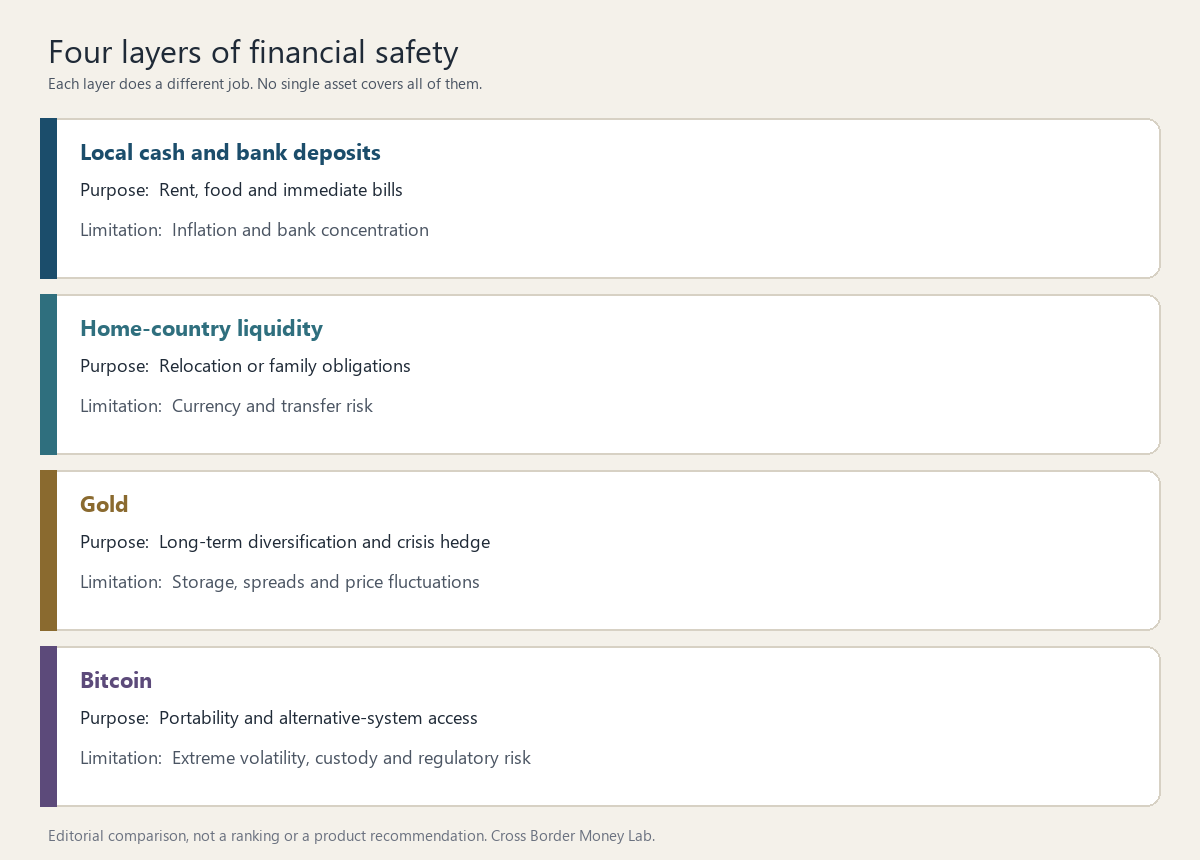
| Financial layer | Primary purpose | Main limitation |
|---|---|---|
| Local cash and bank deposits | Rent, food and immediate bills | Inflation and bank concentration |
| Home-country liquidity | Relocation or family obligations | Currency and transfer risk |
| Gold | Long-term diversification and crisis hedge | Storage, spreads and price fluctuations |
| Bitcoin | Portability and alternative-system access | Extreme volatility, custody and regulatory risk |
Consider an expatriate household that expects to spend QAR 10,000 per month on essential expenses. If it wants six months of protection against job loss, approximately QAR 60,000 must remain accessible.
Putting that QAR 60,000 into gold or Bitcoin could create a serious problem. The household might be forced to sell after a price decline or discover that converting the asset takes longer than expected.
Only money beyond the emergency and relocation reserve should normally be considered for longer-term or higher-volatility assets.
The example is illustrative rather than a recommendation. The correct reserve depends on job security, dependants, insurance, debt, visa conditions and relocation costs.
A Practical Decision Framework
Before buying gold or Bitcoin because of a frightening headline, ask six questions.
1. Is the emergency fund already complete?
Money required within the next several months should prioritise accessibility and stability.
2. What risk is this asset meant to solve?
Gold may help with long-term purchasing-power and portfolio concentration risk. Bitcoin may add portability and exposure outside conventional financial infrastructure.
Neither automatically solves unemployment.
3. Could I tolerate a significant price decline?
A person who would be forced to sell Bitcoin after a sharp fall should not treat it as emergency savings.
4. Do I understand the ownership method?
For gold, this includes authenticity, storage, insurance and resale terms. For Bitcoin, this includes exchange risk, wallet security, private keys and beneficiary access.
5. Is the platform and transaction legal where I live?
Digital-asset rules differ across Middle Eastern jurisdictions and can change. Residents must check the current local regulatory position before transacting.
6. Am I buying according to a plan—or reacting to fear?
Crisis headlines often produce emotional purchases at unfavourable prices. A predetermined allocation, phased buying approach and rebalancing rule can reduce impulsive decisions.
The Bottom Line
The Middle East’s search for financial security is changing.
Gold remains the more established crisis diversifier, supported by central-bank demand and centuries of market history. Bitcoin offers something different: digital scarcity, international portability and access outside traditional financial hours and borders.
But Bitcoin’s portability should not be confused with price stability.
The emerging trend is therefore not simply a migration from gold to Bitcoin. It is a move toward layered financial resilience:
- Liquid cash for immediate survival
- Geographic and currency diversification for mobility
- Gold for established long-term protection
- Bitcoin, where appropriate and legal, as a smaller high-risk portability layer
When budgets tighten and jobs become less predictable, the most important asset is not the one generating the most attention.
It is the financial system that prevents one bad event from forcing a household into a desperate decision.
The new safety trade is not gold versus Bitcoin.
It is making sure that no single asset has to do every job.
Build the System Before Choosing the Asset
Gold and Bitcoin can play different roles, but neither replaces accessible emergency money or a clear cross-border financial structure.
What to Do This Week
- Write down your essential monthly expenses in the currency in which they must be paid.
- Record where your near-term essential-expense liquidity currently sits.
- Do not move money needed for essential near-term expenses into gold or Bitcoin.
- Read The Cross-Border Money System to map your cash, transfers, records and longer-term layers.
This is an educational self-audit, not a recommendation to buy, sell or hold a particular asset.
Sources and further reading
- Reuters: Vessels trickle through the Strait of Hormuz as Middle East tension persists
- World Gold Council: Gold Demand Trends
- World Gold Council: 2026 Central Bank Gold Reserves Survey
- Reuters: Gold shows signs of reclaiming safe-haven appeal after Iran war selloff
- Investopedia: Bitcoin’s performance during the war in Iran
- Finance Research Letters: Safe-haven assets and geopolitical risk
- Scientific study: Bitcoin and gold during extreme market conditions
Reviewed: 21 September 2026.
Educational disclaimer
This article is for general educational purposes only. It does not constitute investment, legal, tax or financial advice. Asset prices can fall, and cryptocurrency may not be suitable or legally available in every jurisdiction.
 Cross Border Money Lab