Byline: Cross Border Money Lab Editorial Team
The reader problem
You are shown a small fee, or a fee of zero, and a large receiving-currency number. The decision is whether that quote is the all-in cost of this send, on this corridor, with this payout method, at the minute the payment is processed — not whether a brand is “cheap” in general.
Quotes can change during the same day. Licensed UAE firms are even required, in advertising, to warn that a foreign-currency product may be affected by exchange-rate moves (CBUAE Consumer Protection Standards, section 2.3.5.3).
Short answer
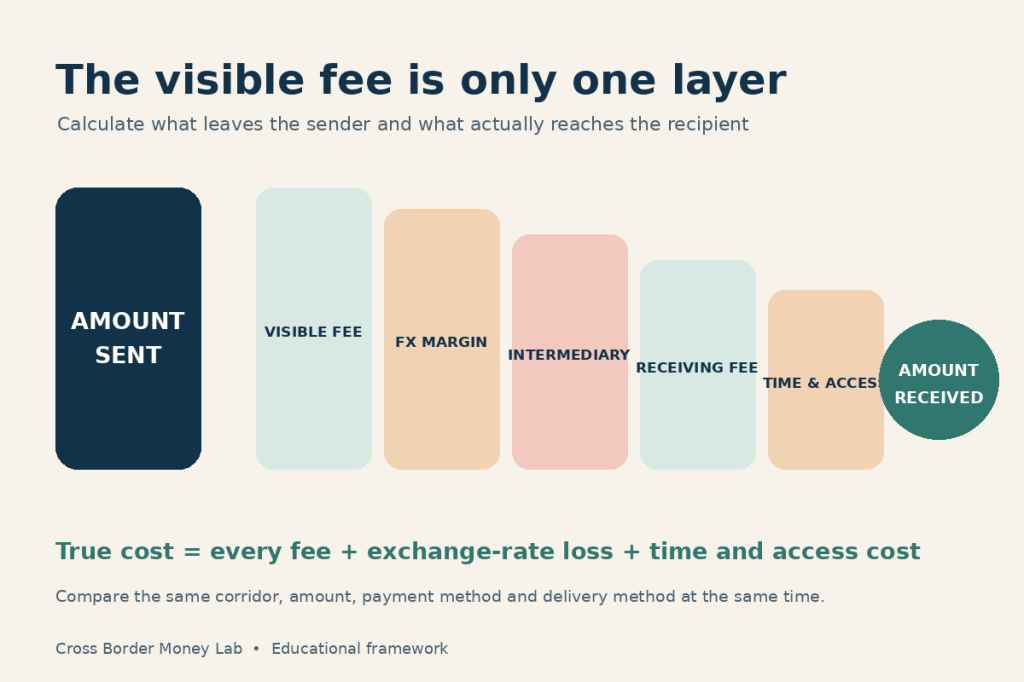
Add six components:
visible transfer fee + exchange-rate margin + intermediary-bank fee + receiving-bank fee + payment and delivery cost + timing and accessibility cost.
The World Bank’s public remittance database officially measures the first two for a standardised USD 200 send. The other four still hit households. There is no durable “cheapest provider” list in this article. If a named bank appears, it is a dated fee-schedule example.
Why generic advice fails in this region
Comparison widgets often show one fee for one amount. They rarely show:
- The margin inside the rate, especially when the sending currency is dollar-linked and the receiving currency is not.
- SHA/OUR/BEN choices that move costs onto the beneficiary.
- Payout rails that only credit a same-group bank.
- Corridors where a “smart” low-cost, fast, accessible service does not qualify in the World Bank SmaRT screen.
RPW Issue 54 (data for Q3 2025, report dated September 2025) recorded a global average total cost of 6.36 percent of a USD 200 send (about USD 12.72). Digital services averaged 4.59 percent; non-digital 7.30 percent. Those are mystery-shop averages of transparent services. Providers that will not disclose the rate are excluded — which means a suspiciously low fee with a hidden rate is exactly the case the average is trying not to reward.
Receiving-region averages in the same report:
| Receiving region (RPW grouping) | Average total cost, send USD 200, Q3 2025 |
|---|---|
| Middle East, North Africa, Afghanistan & Pakistan | 5.11% |
| South Asia | 5.30% |
| Sub-Saharan Africa | 8.46% |
South Asia appears here only as a benchmark: in that quarter it sat close to the MENAAP receiving average and well below the Sub-Saharan Africa receiving average. It is not this publication’s core editorial region. Saudi Arabia, as a G20 sending country in the same report, averaged 5.52 percent for a USD 200 send. South Africa, as a G20 sending country, averaged 15.65 percent — useful context if money also leaves Johannesburg, not a GCC ranking.
Issue 54 lists Qatar→Egypt, Qatar→Sudan, UAE→Sudan, and Saudi Arabia→Sudan among corridors without SmaRT-qualifying services that quarter. That is a service-quality and transparency screen (cost, speed, access). It is not a statement that no one can send.
UN Sustainable Development Goal 10.c, as used in the same RPW report, has two different tests: a global average heading toward 3 percent of the amount sent by 2030, and a corridor test that it should be possible to send for 5 percent or less. In Q3 2025, RPW reported that 78 percent of covered corridors had SmaRT averages below 5 percent. A household quote at 4 percent can still fail you if payout takes too long. Policy targets are not a personal rate guarantee.
Decision framework: the six-component formula
1. Visible transfer fee
The number on the receipt. In the UAE, licensed institutions must provide clear information on all applicable fees and the buy and sell exchange rate before you complete a remittance, and should try to disclose correspondent fees or give a range plus a disclaimer (CBUAE Consumer Protection Standards, section 2.1.5.2–2.1.5.5, N 1158/2021, accessed 21 September 2026). If the fee is zero, write zero — then keep going.
2. Exchange-rate margin
RPW defines this as the gap between the rate you are given and the interbank rate. Qatar Central Bank states that, for USD, commercial banks add a 0.24 percent margin to the QCB price when dealing with the public. That is a sourced public USD margin in Qatar. It is not the margin on Kenyan shillings or naira. For other currencies, QCB says banks combine the QR/USD policy rate with the market USD/foreign-currency rate — two steps, even if you see one QR quote.
3. Intermediary-bank fee
SWIFT-style transfers often offer charge codes that decide who pays the banks in the middle. Emirates NBD’s personal banking schedule of charges (PDF accessed 21 September 2026) states that online foreign-currency remittance charges are waived only when the SHARED option is selected, and that correspondent or beneficiary charges may still apply; for OUR on AED transfers outside the UAE, a fee of AED 105 is paid as correspondent bank charges to the UAE Central Bank. That AED 105 figure is product-specific. Do not paste it onto every app send.
4. Receiving-bank fee
RPW’s methodology notes that fees and taxes charged in the recipient country are not always tracked, so actual total costs can be higher than the database. Ask what the beneficiary will be charged to receive into an account, especially a non-partner bank.
5. Payment and delivery cost
How you fund the send (cash, account debit, card) and how the beneficiary is paid (account credit, cash pickup, mobile wallet, same-group bank only) change the all-in number even when the advertised transfer fee does not. A zero-fee send that can only credit a same-group account is a delivery constraint. Cash payout or an extra wallet cash-out is a delivery cost. Record both.
6. Timing and accessibility cost
If school fees, rent, or medicine is due Friday and the rail credits next Wednesday, the late send is expensive. Price the consequence (penalty, extra borrowing, missed discount) as a cost. Speed claims can fail under extra screening; CBUAE standards require a warning that actual time may differ from estimates. Accessibility includes whether the sender and receiver can actually use the rail (ID, bank account, agent hours).
Provider examples (dated, not a ranking)
This is one public fee schedule, not a live FX quote and not a cheapest-provider ranking. Fees and corridors change.
Worked listing (Singapore)
| Field | Recorded value |
|---|---|
| Quote date and time | 21 September 2026, 16:52 Asia/Qatar (13:52 UTC) |
| Sending country | United Arab Emirates |
| Receiving country | Singapore |
| Transfer amount | Illustrative AED 3,673 (about USD 1,000 at the CBUAE sell-USD intervention of 3.673). The public page does not quote this amount. |
| Funding method | Emirates NBD customer DirectRemit (account product). The public page does not name card vs cash vs account debit for this listing. |
| Delivery method | SGD credit; page coverage “All banks”; limit SGD 15,000 |
| Source | https://www.emiratesnbd.com/en/foreign-exchange/directremit |
| Visible fee on that page | AED 26.25 (inclusive of tax) |
| Limitation | Rates on transfer pages are indicative; prevailing rates apply at processing. Correspondent or beneficiary fees may still apply. This is not a logged-in ticket and not a recommendation. |
The same page, captured at that timestamp, also listed:
| Receiving listing | Visible fee (incl. tax where shown) | Delivery note on the page |
|---|---|---|
| India (INR), limit 1,000,000 | Zero | “All banks.” South Asia benchmark corridor only |
| Europe (EUR), limit 15,000 | AED 26.25 | — |
| United Kingdom (GBP), limit 25,000 | Zero | — |
| Philippines (PHP), limit 50,000 | Zero | — |
| Pakistan (PKR), limit 1,000,000 | Zero | — |
| Sri Lanka (LKR), limit 999,999 | Zero | — |
| Hong Kong (HKD), limit 15,000 | AED 26.25 | — |
| Australia (AUD), limit 15,000 | AED 26.25 | All banks; same-day vs next-day note if started before 1:00 pm Mon–Fri |
| Egypt (EGP), limit 250,000 | Zero | Only to Emirates NBD Egypt bank accounts |
The page marketed DirectRemit as available 24/7. Egypt is in the later Africa corridor set. The useful fact is the rail constraint, not the zero. A zero fee that cannot pay out to the parent’s local bank is not a complete product for that household.
Illustrative arithmetic (assumptions labelled). Using the Singapore listing above: visible transfer fee = AED 26.25. The page does not publish an FX-margin percent. If — and only if — you assume a 1 percent exchange-rate margin for teaching the formula, FX = AED 36.73. Known fee plus assumed margin = AED 62.98 before unknown intermediary, receiving-bank, payment/delivery extras, and timing cost. Do not treat 1.71 percent as Emirates NBD’s price. Recompute with the rate printed at processing.
Branch telegraphic transfer is a different product: the same bank’s personal SOC lists foreign-currency remittance through branch at AED 78.75 for several packages (PDF accessed 21 September 2026). Channel choice is part of payment and delivery cost.
Common mistakes
- Stopping at “fee = 0.”
- Comparing a cash payout to an account credit.
- Reusing yesterday’s rate screenshot.
- Treating a GCC→India zero-fee listing as proof that GCC→Lagos will look the same.
- Building a personal “cheapest” spreadsheet and never dating the rows.
When this does not apply
- Purely domestic transfers inside one currency and one licensing perimeter.
- Large wholesale FX deals under a corporate ISDA-style relationship — different documents.
- Situations where you are being asked to move someone else’s money, split a payment, or hide the purpose. That is a scam-screening problem, not a fee problem.
Action checklist
- Write the corridor, amount, and payout method.
- Capture fee, buy/sell rate, and timestamp.
- Ask SHA/OUR/BEN or the local equivalent.
- Ask receiving and cash-out fees.
- Check licence (UAE: CBUAE register, August 2026 edition at time of research).
- Check whether payout is “all banks” or same-group only.
- Record time to availability, not marketing speed.
- Repeat the quote immediately before you confirm — same-day change is normal.
Related Cross Border Money Lab articles
- The Cross-Border Money System — where remittance sits in the household map.
- Upcoming: How Much Emergency Cash Should an Expat Keep? — why origin-side money is not instant liquidity.
Sources and reviewed date
Reviewed on 21 September 2026.
- World Bank, Remittance Prices Worldwide, Issue 54 (Q3 2025 / September 2025).
- CBUAE Consumer Protection Standards N 1158/2021, sections 2.1.5 and 2.3.5.
- CBUAE, CB Register as of August 2026.
- Qatar Central Bank Exchange Rate Policy — 0.24 percent public USD margin.
- Emirates NBD DirectRemit page (captured 21 September 2026, 16:52 Asia/Qatar) and Personal Banking Schedule of Charges PDF (accessed 21 September 2026).
Educational disclaimer
This article is for general education. It is not legal, tax, or investment advice, and Cross Border Money Lab is not a licensed financial adviser. Rules, fees, and product terms change. Check the official source for your country, and a qualified professional where a decision is high-stakes. Named providers are examples from public schedules, not recommendations.
 Cross Border Money Lab