New seats, possible timetable changes and a teacher well-being plan still being written do not replace a comparison of cash, time and what still works if a job or a sibling’s timetable moves.
Why This Matters
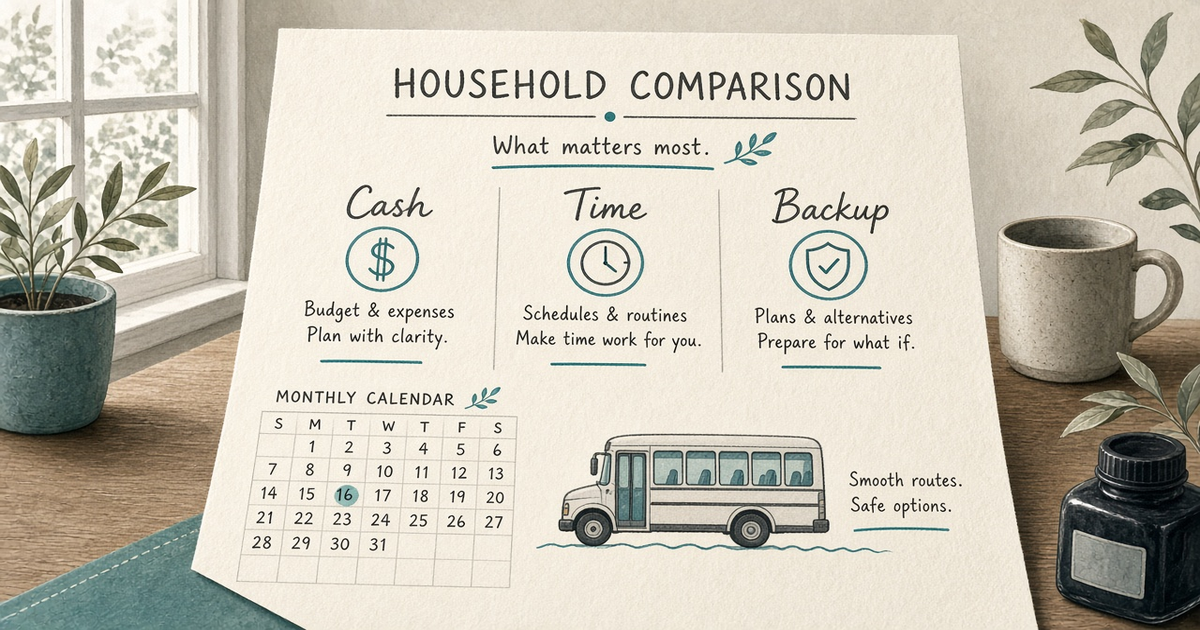
A school place in Dubai is not only a curriculum choice. It is a payment calendar, a daily timetable, and a switching cost if work, housing or a sibling’s year group changes.
In the first days of October 2026, Dubai’s Knowledge and Human Development Authority (KHDA) described more private-school capacity, said schools may change start times only with approval, and said an educator well-being strategy is still being written. Those are useful public facts. They are not a family’s fee sheet, bus contract or specialist-teacher roster.
The missed cost is often not the brochure tuition. It is the cash that has to leave the account before any employer contribution arrives, the extra hour that cannot be billed or parented at the same time, and the arrangement that only works on a normal Tuesday.
Key Points
- Tuition is the regulated core. Transport, after-school care and many activities sit beside it and can erase a “cheaper” school.
- A shorter map distance can still clash with two workplaces or two pickup times.
- A routine that works every week is not the same as a routine that survives overtime, travel or an early finish.
- New seats are not a place in the needed grade, curriculum, budget band or support setting.
- Facilities do not answer who covers the class if a teacher leaves mid-term.
- A good current fit can become expensive to unwind if the job or the sibling map changes.
AUDIO INSIGHT BRIEFING
Listen to the key implications in under three minutes (2:17).
READ THE FULL ANALYSIS BELOW ↓
What KHDA Said — and When
On 1 October 2026, the Emirates News Agency (WAM) reported that KHDA set out 2026–27 priorities at a Media Majlis. The authority said Dubai private schools had 406,563 students at the start of the new academic year, compared with about 388,731 in June 2026, a 4.6 per cent rise.[1]
WAM also reported 51 new private educational institutions over two academic years, and 26 this year: 17 early childhood centres, seven schools and two international higher-education institutions. The new schools added nearly 17,000 seats. The new centres are described as adding more than 1,700 seats. About 18,000 “affordable” seats are expected over the next two academic years.[1]
Those are sector totals. They do not name a year group, a curriculum or a neighbourhood.
The same week, Gulf News reported Aisha Miran, KHDA’s director general, saying schools may change timings to ease traffic if they have prior KHDA approval, put student well-being first, and take parents into account. KHDA cannot impose one timetable on every curriculum. The newspaper also said some schools have already begun staggered starts.[2] That is not a city-wide new bell time.
On 5 October 2026 — World Teachers’ Day — Gulf News reported that KHDA is developing an educator well-being strategy covering recruitment through retention, with professional development, recognition and work-life balance as the three stated pillars. The strategy is still being developed. Miran said she hopes further details can be shared next year. Asked about teachers leaving mid-semester, she said students can be left without a specialist, and that KHDA is collecting data.[3]
These are not all 5 October announcements. The Media Majlis reporting is dated 1 October. The well-being strategy is a plan, not a published staff-retention rule.
How the Announcement Reaches a Household
Capacity, clocks and staffing reach family money in different ways.
Seats. More institutions can shorten a waiting list in one year group and leave another untouched. A family still has to match curriculum, location, budget and any additional support. Expected “affordable” seats are a KHDA outlook, not a delivered place and not a forecast that tuition will fall.
Clocks. An approved stagger can cut a jam at the gate. It can also split two children’s mornings so one adult makes two loops. Time is a coordination problem. It is not automatically lost wages.
Staffing. A well-being strategy aimed at the next year may, if it works, reduce mid-year disruption. Until it exists as an operating rule, a parent still has to ask the school how handover, specialist cover and parent communication work when a teacher leaves.
Cash timing. KHDA’s parent FAQ for the registration and refund policy, effective 23 March 2026, says tuition may be collected in three term instalments — first term not more than 40 per cent of annual tuition, then not more than 30 per cent and 30 per cent — or as ten equal monthly instalments. Application, registration and re-registration deposits are capped and, where paid, are treated as advances or separate processing fees — not as optional extras a family can ignore.[4] Those caps apply to Dubai private schools under that policy. Check the school’s current School Fees Fact Sheet for this academic year. Employer help, if it exists, has its own dates. The gap between the school due date and the reimbursement date is a cash-flow problem even when the annual total looks manageable.
School Price Versus Household Burden
Compare the year, not the brochure line.
KHDA regulates tuition and related enrolment charges. In the same registration policy, transport, extracurricular activities, trips and similar items are optional services offered by the school or a third party, on the terms the parent actually signs.[4]
A working split:
Tuition. Recurring on the school’s term or monthly calendar. A registration deposit, if paid after an offer, is an advance against tuition — not a second annual fee — if the child starts. Subtract employer help only if the written policy covers that child, that school and that year.
Application fee. One-off. Up to AED 500 under the KHDA parent FAQ effective 23 March 2026; not deducted from tuition. Employer help is rare.
Re-registration deposit. Annual if the child continues. Not more than 5 per cent of annual tuition or AED 500, whichever is higher, and deducted from next year’s tuition if the child returns. Check the school’s Fact Sheet before treating it as extra spend.
Bus, uniform, exams, clubs, after-school care. Often recurring if used. Exit terms sit in the optional-service contract. Subtract employer help only if those lines are named.
Do not invent a “typical Dubai fee.” Read the school’s KHDA School Fees Fact Sheet and the parent contract. Subtract employer support only when the HR document names the school type, the child and the payment date. Many packages contribute nothing.
Distance Versus Daily Coordination
A twelve-minute drive can fail two working adults if pickup is at 14:40 and both meetings end at 15:30. A forty-minute bus can work if the bus is real, the stop is usable, and after-school cover exists on the days it does not.
Ask, as facts, not as a vibe:
- What is the actual first bell and the actual supervised end of the day?
- Is there a bus with a published stop, or only a hope that one will be added?
- Can one adult cover both children on the same afternoon?
Time and money belong in separate columns. An extra 40 minutes on a school day is 40 minutes of someone’s schedule. Count lost pay or paid care only if those hours are actually lost.
Illustration, labelled hypothetical. Suppose one adult spends an extra 40 minutes of door-to-door time per school day — the extra morning minutes plus the extra afternoon minutes — compared with a nearer school. Over a hypothetical month with 20 school days, that is 800 minutes, or 13 hours and 20 minutes. The 40 minutes already include both ends of the day. Not every month has 20 school days; holidays move the count around. This is a schedule burden, not a forecast of lost earnings.
Normal Schedule Versus Backup
The useful question is not “who does pickup on a calm Tuesday?” It is “who does pickup when a flight is delayed, a client overruns, or the school calls at 11:00?”
Backup is a named person or a paid service that is actually available. It is not “we will figure it out.” Do not assume a grandparent is in Dubai, or that a nanny day is bookable at two hours’ notice.
If the only backup is unpaid leave, that leave has a cash effect. If there is no backup, the school choice has an operational limit even when the tuition looks fine.
Aggregate Seats Versus a Suitable Place
Seven new schools and nearly 17,000 new seats are a city-level supply figure.[1] A child needs a place in a specific year, with a specific curriculum, in a workable location, at a payable price, with any required support.
Expected affordable seats over two years are an outlook. They do not prove that this year’s invoice will be smaller. They do not prove that a sibling will be admitted next year.
Ask the school, in writing, what is actually open for the intake year. A directory listing is not an offer.
Facilities Versus Continuity
A new building is easy to photograph. Continuity is a process: who teaches the class next week if someone leaves, who covers a specialist subject, and how parents are told.
KHDA is collecting data on mid-semester exits; a substitute may not be a subject specialist.[3] That is a reason to ask the school how it handles handover. It is not a rate of turnover, and it is not a verdict on any named campus.
Higher fees do not guarantee retention. A well-being strategy hoped for next year is not this term’s staffing plan.
Current Fit Versus Switching Burden
A school that fits this posting can still be costly to leave. Under the KHDA parent FAQ effective 23 March 2026, refunds run from the withdrawal date on the withdrawal certificate, not from the last day the child attended. A transfer certificate can be withheld until fees are settled, and it is required to register at another private school in Dubai and across the UAE.[4]
Housing and school lock together. A shorter commute to a new office can mean a longer school run, or a second deposit if the family moves community. Child well-being and curriculum fit remain real constraints. They are not a reason to skip the cash and time columns.
Treat a possible job-location change as a conditional test, not a prediction that the employer will move anyone.
Three Household Tests (Hypothetical)
These are planning cases. They are not typical Dubai families, forecasts, or ranked likelihoods. Figures are illustrative. They use dirhams because the invoices are.
Assumptions shared by all three: one school year; no second undeclared fee; bus and after-school costs are optional services the household would actually buy; no double-counting of a bus charge already inside tuition; employer help is zero unless stated.
1. Dual-income household, one child
School Near: hypothetical tuition AED 52,000. No bus. One adult can collect at the published finish time, so paid after-school care is AED 0.
School Far: hypothetical tuition AED 42,000. Bus AED 8,000. Paid after-school care AED 9,000 because both adults finish after the last bell.
Swipe to compare
| School Near | School Far | |
|---|---|---|
| Tuition | 52,000 | 42,000 |
| Bus | 0 | 8,000 |
| After-school care | 0 | 9,000 |
| Year cash outlay | 52,000 | 59,000 |
The AED 10,000 tuition gap is more than used up. Mechanism: optional services attach to the cheaper campus because of distance and work hours. Missing evidence: the real Fact Sheet, the real bus contract, and whether either adult’s hours actually allow a 14:40 pickup. Implication: a “saving” that exists only on the tuition line is not a saving.
2. Employee whose work location may change
Today the school is twelve minutes from the office. Drop-off fits. Conditional test: the same school, the same child, but the workplace moves across the city.
If the extra door-to-door time is the hypothetical 40 minutes per school day used above, a 20-school-day month is 13 hours 20 minutes of one adult’s time. Cash may be unchanged if there is still no bus. The arrangement can still fail because pickup no longer fits the new office hours.
Missing evidence: whether the employer will move anyone, and whether an approved timetable change at the school would help or split the day further. Implication: convenience today is not a test of convenience after a posting change.
3. Household with two children
Hypothetical times, not a named school: Child A’s day starts at 07:30. Child B’s school starts at 08:45 after a stagger of the kind KHDA says needs prior approval and parental consideration.[2] No shared bus.
Two adults can split the loops. One adult cannot, unless paid cover exists for the gap. Backup: either a named person who is free at 07:15, or a paid service with a known daily rate — not an assumed relative.
Missing evidence: the actual approved times at the two schools, sibling-admission rules, and the real price of cover. Implication: two “good” schools can still produce an impossible Tuesday.
A Comparison Worksheet
Do not weight the columns into a single “best school” score. Fill what is known; leave blanks where the Fact Sheet, contract or HR policy is missing.
Tuition and regulated enrolment charges. Cash this year: ____ AED. Time and operational fit: usually not applicable.
Bus, parking or second drop-off. Cash this year: ____ AED. Minutes per school day, and whose time: ____.
After-school or holiday cover you would actually buy. Cash this year: ____ AED. Named backup, or none: ____.
First-term cash due before any reimbursement. Cash this year: ____ AED. Employer payment date, if any: ____.
If the workplace or community changes. Switching fees and overlapping rent, if any: ____ AED. Extra minutes, and whether the place still exists for this child: ____.
A blank line is information. It means the family does not yet have the document.
What This Means for a Longer-Term Financial Plan
The annual education burden is the sum of tuition and the related costs the household will actually pay. The cash that must be found on a due date can be larger than a twelfth of that sum, because the first term can be up to 40 per cent of annual tuition, and because optional services are often due on their own calendar.[4]
If an employer contributes, the contribution is not cash in the school’s account until it is paid. Coverage, caps, which children qualify, which invoices count, what documents are needed, and what happens if the job ends are questions for that employer’s written policy. They are not universal Dubai rules.
A lower tuition line becomes extra money that could be saved or invested only after bus, care, deposits and the rest of the year’s obligations. Even then, “could” is not an instruction to buy a fund, a property, or a stock.
School invoices are dated. Long-term assets move. Using a volatile holding to meet a term bill can force a sale at an inconvenient price. That is a liquidity mismatch. It is not a forecast that markets will fall, and it is not personal investment advice.
New seats and expected affordable capacity do not, by themselves, prove that education companies will be more profitable or that nearby property will rise. Demand, location, fees, costs and valuation each need their own evidence. This set of KHDA updates is not a trade: there is no verified price, no instrument, and no listed education or real-estate conclusion that follows from the Media Majlis. The useful judgment is household-level: total burden, payment dates, and whether the arrangement still funds the family’s other goals.
What to Watch Next
- The named school’s current KHDA School Fees Fact Sheet and parent contract, including optional-service refund terms.
- Whether that school has a KHDA-approved timetable change, and how parents were consulted.
- Publication of the educator well-being strategy, hoped for next year, and any school-level handover policy you can actually read.
- Offers — not listings — in the needed year group and curriculum, including any additional-support place.
- The employer’s next education-benefit payment date, if any, versus the next term due date.
- Re-registration windows (the policy sets earliest collection dates after spring or winter break, depending on a September or April start).[4]
Takeaways
A family can leave this article able to put tuition, transport, care and first-term cash on one page, put time in a second column, and test a job or sibling change without treating KHDA’s city totals as a personal offer. The October updates change the public backdrop. They do not complete the worksheet.
Educational disclaimer
This article is for general education. It is not legal, tax, school-placement or investment advice, and Cross Border Money Lab is not a licensed financial adviser. KHDA rules, school fees and employer benefits change. Check the official document for the school and the employer, and a qualified professional where a decision is high-stakes.
Related Reading
How Much Emergency Cash Should an Expat Keep?
Sources
- Emirates News Agency (WAM), “KHDA shares latest educational developments and priorities for 2026-27 academic year,” 1 October 2026, 17:09 Gulf Standard Time. Access 5 October 2026.
- Sajila Saseendran, Gulf News, “KHDA to allow Dubai schools to change timings to ease traffic, under conditions,” updated 1 October 2026, 16:12 as shown by the publisher. Access 5 October 2026.
- Sajila Saseendran, Gulf News, “Dubai KHDA to unveil teacher well-being strategy to attract and keep world-class educators,” updated 5 October 2026, 04:30 as shown by the publisher. Access 5 October 2026.
- Knowledge and Human Development Authority, “School Registration & Refund Policy for Private Schools in Dubai (Effective March 23, 2026) Frequently Asked Questions — For Parents.” Official KHDA PDF accessed 5 October 2026. Applies to Dubai private schools. A school’s current KHDA School Fees Fact Sheet still has to be read for that campus and year. The HTML parent FAQ page on KHDA’s site returned HTTP 200 on a headline check; the body fetch timed out in this session. The 22 May 2026 KHDA notice freezing 2026–27 fee increases is a separate rule about whether tuition may rise; it does not replace these collection and refund questions.

