A packed venue is easy to see. Whether visitor spending reaches independent restaurants, shops and service firms depends on location, routes, margins and repeat custom.
This voice briefing is no longer available.
Why This Matters
A full stadium is visible. The economic benefit outside it is harder to see.
Qatar’s sports calendar can fill hotels, crowd taxis and lengthen restaurant queues. It can also leave an independent café two kilometres off the visitor route with a quieter evening than usual, because regulars stayed home to avoid congestion. A sports event becomes meaningful to a small or medium-sized enterprise only when visitor movement produces measurable spending at that firm’s location.
That distinction matters more in a slower year. Qatar Tourism reported 5.1 million international visitors in 2025, up 3.7 per cent, with December activity lifted by major events including the FIFA Arab Cup.[3] Those are 2025 figures, not 2026 results. Through August 2026, Qatar Tourism data reported by The Peninsula put arrivals at 2.338 million, after a sharp drop to 63,000 in March and a later recovery to 303,000 in August.[5] Hotel occupancy, according to Qatar Tourism figures cited in a late-August Cushman & Wakefield briefing, softened to 52 per cent in the second quarter, from 71 per cent a year earlier.[6]
Sports events are being asked, in that setting, to do more than entertain. They cannot automatically repair a slowdown. The useful question is not “Are sports events good for the economy?” It is: which event moves which customers through which location, and how much of that spending reaches independent businesses?
Key Points
- Event spending can reach hotels, food, transport, retail, delivery, staffing and local services. It does not reach them evenly.
- Official vendors, sponsor networks and venue concessions often capture the first slice of visitor money.
- Regular customers may stay away. Traffic can rise while net revenue does not.
- A short calendar window is easy to over-stock and over-staff.
- The test that matters is margin, new customers and 30-day return visits, not a busy night alone.
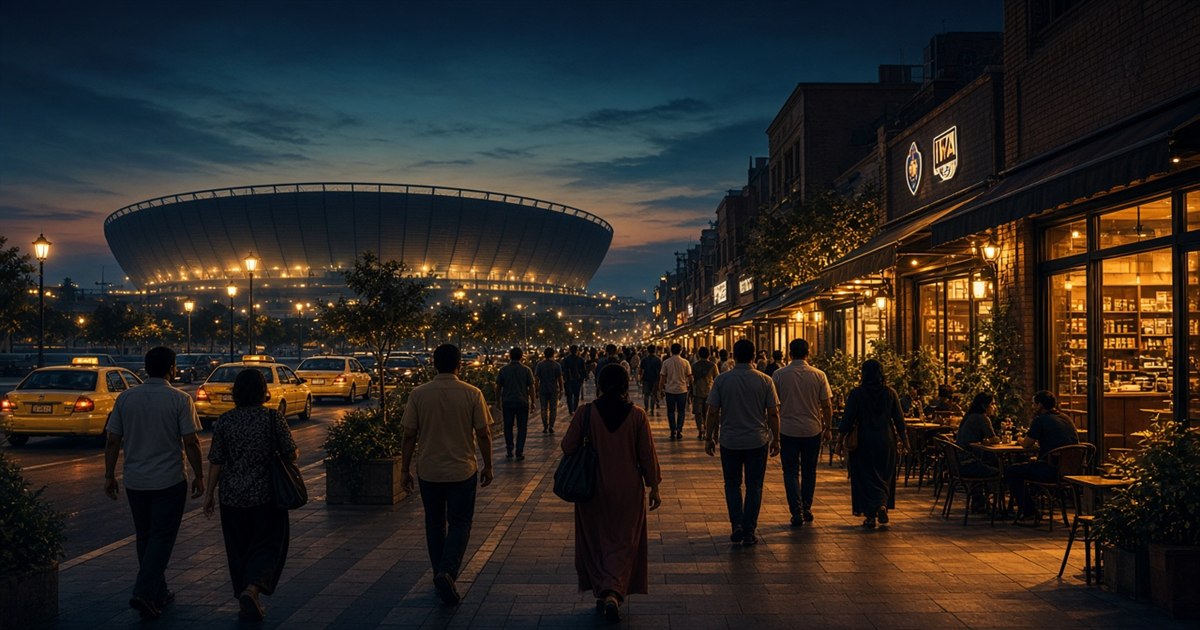
How Sports Spending Reaches the Local Economy
Visitor money does not stay in the stands. It moves, if it moves at all, through a chain.
Accommodation. Overnight guests buy rooms, breakfasts and late check-outs. That is usually the largest single event line. It also sits mainly with hotels and serviced apartments, not with a neighbourhood grocer.
Food and beverage. Pre-match meals, post-match gatherings and match-day delivery can lift restaurants and cafés near visitor routes. They can also concentrate inside the venue.
Transport. Taxis, ride-hailing, car hire and extra metro or bus trips rise when people who do not know the city need to move on a deadline.
Retail. Convenience stores, pharmacies and small gift shops near stations and hotels may see short spikes. Specialist retail further away may see nothing.
Delivery. Platforms can capture orders from people who would rather not fight traffic. Commission then takes a share of the ticket.
Event operations. Temporary security, cleaning, ushering, logistics and technical crews are paid work. Much of it is contracted, and much of it ends when the event ends.
Content, marketing and translation. Listings, maps, social posts, photography and language help can matter for firms trying to be found by visitors who will not return to a familiar street.
Qatar Tourism’s September calendar listed a dense mix of sport, culture and entertainment. Confirmed sporting fixtures included the Qterminals Qatar Classic squash tournament (12–18 September) at Khalifa International Tennis and Squash Complex, and the 1st Qatar Asian Junior Tournament 14 & Under, running 28 September to 3 October at the same complex.[1] Those are real dates. They are not a World Cup.
Separately, the 3-2-1 Qatar Olympic and Sports Museum is offering public screenings of the 27th Arabian Gulf Cup on a big screen outside the Esports Lounge on Level 7, from 23 September to 6 October.[2] That is a screening programme in Doha. It is not Qatar hosting the Gulf Cup.
The transmission is simple:
Visitors and residents move toward a venue → they buy time, food, transport and incidentals along the route → some of that spending stays with independent firms → some leaks to official vendors, platforms and one-off labour.
If the route never passes the shop, the shop is not in the economy of that event.
Why the Benefit Is Uneven
Distance is the first filter. A restaurant on the walk from a metro station to a stadium has a different night from a restaurant in a residential compound with the same cuisine.
Official vendors and sponsors are the second. Tickets, official merchandise, venue catering and hotel packages are designed to keep spending inside a controlled circuit. Independent firms compete for whatever is left.
Congestion avoidance is the third. Regulars who would have dined locally on a Tuesday may order in, drive to another neighbourhood, or stay home. The event then displaces demand rather than adding to it.
Duration is the fourth. A three-day junior tennis event is not a month-long tournament. Inventory bought for a spike can still be in the fridge on Thursday.
Then come the quiet leaks: extra staff who cannot be sent home at 9pm, delivery commissions, discounts that raise order counts while shrinking contribution per ticket, and marketing spend that attracts one-time visitors who never come back.
North America’s 2026 World Cup is useful as a comparison, not as a forecast for Qatar. Bank of America Institute card data, published on 6 August, found that in-person spending in U.S. host cities rose around 5 per cent year on year over the tournament, led by visitors rather than locals. Restaurants and bars were the clearest beneficiaries. The same research judged the effect on overall U.S. spending and GDP to be more modest, in part because some spending moved from non-host to host cities.[7]
Reuters, reporting from Mexico on 17 July, described packed stadiums that still fell short of official tourism targets. Banorte cut its estimate of the tournament’s GDP contribution. Deloitte projected 100,000 temporary jobs, 10 per cent fewer than an earlier estimate. BBVA’s June household consumption indicator fell 0.2 per cent month on month, with hotel spending down 10.5 per cent and restaurant spending down 4.9 per cent even as entertainment jumped. The Mexican Restaurant Association said half of its establishments performed worse than in a typical week.[8]
Those findings do not predict Doha. They show the mechanism: a visible crowd can coexist with weak net sales and demand that moved rather than multiplied.
Who May Benefit
| Type of business | Potential opportunity | Main risk | Metric to track |
|---|---|---|---|
| Restaurants and cafés | Pre- and post-event covers on visitor routes | Regulars stay away; discounts cut margin | Covers, average ticket, contribution per cover, share of new vs returning guests |
| Delivery businesses | Orders from people avoiding traffic | Platform commission; packed kitchens; late-night labour | Orders, commission net of ticket, delivery time, complaint rate |
| Retail and convenience | Incidentals near hotels, stations and venues | Short spike; leftover stock | Units sold, waste, basket size, stock that remains after the event |
| Transport services | Airport, hotel and venue trips | Congestion, wait times, one-way dead miles | Trips, occupancy, idle time, net per trip after fuel |
| Tourism and experience providers | Packages around a known date | No-shows; spending captured by official tours | Bookings, show-up rate, ancillary spend, repeat enquiry |
| Content, media and marketing | Listings, maps, language and social explainers | Time spent on posts that do not convert | Profile views, map clicks, calls, tracked promo codes |
None of these rows is a recommendation to expand. Each is a place to measure.
What a Slower Economy Changes
A sports date does not cancel the rest of the year. Qatar’s 2026 state budget set expected expenditure at QR220.8 billion against expected revenue of QR199.0 billion, a planned deficit of QR21.8 billion.[10] That is the official budget frame, not a description of every ministry or every private firm.
In August, Qatar’s foreign ministry spokesman, Dr Majed bin Mohammed Al Ansari, said figures in a Financial Times report about budget reductions of up to 30 per cent at government agencies were “inaccurate” and taken out of context. He said talk of a 30 per cent reduction related to precautionary measures at the start of the regional crisis, applied to operational expenses only, and did not include salaries or capital projects.[9]
That official clarification matters. Reported cuts should not be treated as a uniform haircut on every public body, state company or SME. Households and firms still feel a quieter economy through slower footfall, tighter corporate entertaining, and more caution about extra shifts. In that climate, an event is a test of timing, not a substitute for a year’s demand.
Three Operating Scenarios
These are planning cases, not forecasts.
Scenario 1 — Strong visitor spillover. Visitors stay in the area before and after the session. They eat outside the venue, use local taxis and buy incidentals. Independent firms on the route see new tickets and can name where those customers came from. Net revenue on the event day exceeds a comparable ordinary day after labour, waste and discounts.
Scenario 2 — Concentrated event spending. The stadium or screening site is busy. Most money stays with official catering, hotels on package rates, malls and sponsor networks. Nearby independents see crowds on the pavement and little extra in the till.
Scenario 3 — Displacement. Traffic, road closures and noise rise. Regular local customers stay away. Event visitors do not replace them. The night looks busy from the street and finishes close to, or below, a normal equivalent day once extra costs are counted.
A screening at a museum and a multi-day international junior tournament can produce different scenarios on the same calendar. The Asian Junior event at Khalifa International Tennis and Squash Complex runs through 3 October.[1] Gulf Cup screenings at 3-2-1 run through 6 October.[2] Family groups walking from a museum café have a different ticket, dwell time and route from junior-tennis parents with a full-day schedule. Treat the dates as separate tests.
A Seven-Step SME Event Test
- Review the next 30 days of official calendars. Start with Qatar Calendar / Visit Qatar listings, not social rumours.[1]
- Select only events relevant to the firm’s customers and location. A late-night café near a screening is not the same business as a weekday lunch counter 20 minutes off the route.
- Map expected movement before, during and after the session. Airport to hotel, hotel to venue, venue to food, food to transport home. If the map never touches the door, do not staff for a peak.
- Repackage what you already sell. A set menu, a pre-order window, a family platter or extended coffee hours beats a new product line bought on hope.
- Update Google Maps, social profiles, opening hours and how to reach the door. Visitors follow maps. A closed-looking shutter and an outdated hour are enough to lose the walk-by.
- Record the day. Revenue, order count, average ticket, estimated margin, new versus known customers, and how they said they found you.
- Compare with a normal equivalent day, then watch 30-day return visits. A spike that never returns was entertainment traffic, not a new customer base.
Keep the test small. Extra inventory, extra staff and deep discounts are how a short event becomes a longer cost.
What This Means for Households and Workers
Event weeks can shift hospitality hours, add temporary stewarding or delivery shifts, and raise the price of a taxi or a late meal near a venue. They can also end on Monday.
Temporary demand is not a hiring plan. Deloitte’s downward revision of World Cup job estimates in Mexico is a reminder that event labour is often shorter and smaller than the pre-event brochure.[8] In Qatar, the same caution applies: a few busy nights do not become a permanent contract.
For workers, the skills that travel beyond one fixture are practical: languages, customer handling, event operations, digital listings and tourism service. Those skills have value if they transfer to the next calendar date. They are not a promise of year-round overtime.
Households should treat event-week prices as a local, short window. If food, transport or rooms near a venue jump, that is a timing and location effect. It is not proof that the national cost of living has moved by the same amount.
Practical Interpretation
Sports events are not an automatic rescue plan for a slow economy. They are temporary concentrations of attention and movement.
SMEs benefit when they prepare around customer routes, timing, relevance and measurable economics, and when they avoid betting heavily before demand is proven. The owner who records one comparable day, one event day and one month of return visits knows more than the owner who remembers that the street looked full.
A stadium can be full. The till still has to be counted.
What to Watch Next
- International visitor arrivals, including monthly prints from Qatar Tourism, labelled by year so 2025 is not confused with 2026.[3][5]
- Hotel occupancy and average daily rates, especially whether event weeks lift independent neighbourhoods or only venue-adjacent stock.[6]
- Footfall outside official venues, not only inside them.
- Restaurant and retail sales by location, not a city-wide average.
- Whether SMEs can actually sell into event procurement, or only watch official vendors do so.
- Temporary versus continuing employment after the fixture.
- Customer return rate over 30 days.
- Margin, not just revenue.
Qatar Tourism’s sector-statistics page hosts quarterly reports and dashboards.[4] As of 28 September 2026, this article uses the 2025 official performance release plus 2026 arrival and occupancy figures as reported from Qatar Tourism by Qatari press. It does not treat an undated dashboard screenshot as a replacement for a dated report.
Related Reading
- When Gulf Flights Are Disrupted: The Hidden Costs Moving From Airports to Everyday Prices
- UAE Fuel Prices for October 2026: What a 10-Fils Move Would Mean for Households and Small Businesses
- The Fed Raised Rates. Why GCC Mortgages, Deposits and Small Businesses Feel It So Quickly
- If Hormuz Reopens, Why Gulf Prices May Stay High Longer Than Expected
Sources
- Qatar Tourism — Qatar Calendar presents international exhibitions, entertainment, cultural and sporting events throughout September, accessed 28 September 2026. Includes Qterminals Qatar Classic squash, 12–18 September 2026, and the 1st Qatar Asian Junior Tournament 14 & Under, 28 September–3 October 2026, at Khalifa International Tennis and Squash Complex.
- 3-2-1 Qatar Olympic and Sports Museum, accessed 28 September 2026. Featured event: Arabian Gulf Cup live screenings outside the Esports Lounge on Level 7, 23 September–6 October. Public screenings, not a claim that Qatar is hosting the tournament.
- Qatar Tourism — Qatar Tourism marks 2025 as a year of global milestones and resilient growth, accessed 28 September 2026. 5.1 million international visitors in 2025; 3.7 per cent annual growth; 674,000 visitors in December, nearly 16 per cent higher than a year earlier, driven by major events including the FIFA Arab Cup Qatar 2025. 2025 figures only.
- Qatar Tourism — Sector statistics, accessed 28 September 2026. Official page for quarterly performance reports and dashboards. No separate, clearly dated 2026 quarterly PDF was confirmed from this page at access; 2026 arrival figures below are Qatar Tourism data as reported in the Qatari press.
- The Peninsula — Qatar welcomes over 2.3 million visitors in eight months of 2026, 3 September 2026, citing Qatar Tourism. 2.338 million visitors January–August 2026; 303,000 in August; 63,000 in March; 1.13 million in the first quarter.
- The Peninsula — Hotel supply grows 2.2% YoY to 42,000 keys by June, 28 August 2026, Cushman & Wakefield briefing citing Qatar Tourism data. Q2 2026 occupancy 52 per cent; international arrivals 618,000 in Q2 2026.
- Bank of America Institute — On the ball: World Cup 2026 final score, 6 August 2026. U.S. host-city card spending around 5 per cent year on year over the tournament; restaurants and bars the clearest beneficiaries; modest effect on overall U.S. spending and GDP; likely reallocation from non-host to host cities. Evidence from the 2026 North American World Cup, not a Qatar forecast. A live Reuters article dated 10 July 2026 carrying the 5.3 per cent / 3.8 per cent restaurant prints was not located at execution; those specific prints are therefore not used.
- Reuters — The economic goal that never came: World Cup falls short of boosting Mexico, 17 July 2026, Noe Torres. Uneven local impact; Banorte GDP-contribution cut; Deloitte 100,000 temporary jobs, 10 per cent below a previous estimate; BBVA June consumption and hotel/restaurant prints; Mexican Restaurant Association: half of establishments worse than a typical week.
- The Peninsula / QNA — Talk of 30% budgets reduction related to precautionary measures, 25 August 2026. MoFA spokesman Dr Majed bin Mohammed Al Ansari: FT figures inaccurate and out of context; 30 per cent talk related to precautionary operational expenses only, not salaries or capital projects.
- Ministry of Finance — State Budget 2026, accessed 28 September 2026. Expected revenue QR199.0 billion; expected expenditure QR220.8 billion; expected deficit QR21.8 billion.

