AUDIO INSIGHT BRIEFING
Listen to the key implications in under three minutes (1:54).
READ THE FULL ANALYSIS BELOW ↓
Why This Matters
A robot demonstration puts the machine at the centre of the story. A business installing one has a different concern: whether a particular job will work reliably in its own operation.
The distance between those two situations could create work beyond manufacturing. Someone may need to define the task, connect the equipment, train staff, resolve faults and keep the system useful as the workplace changes.
Those are possible roles, not a queue of guaranteed contracts. A prospective business owner or worker needs to identify the customer, the required capability and the costs of taking responsibility before investing in the opportunity.
Key Points
- A partnership discussion is evidence of interest, not proof of a funded factory or a local customer base.
- Making a robot and making it useful at a customer’s site are different activities.
- Recurring service revenue requires deployed equipment, paying customers and support that can be delivered economically.
- Local assembly does not by itself establish local control of technology or attractive margins.
- A narrow, paid task can be a better starting point for testing a business than a broad promise to participate in “physical AI.”
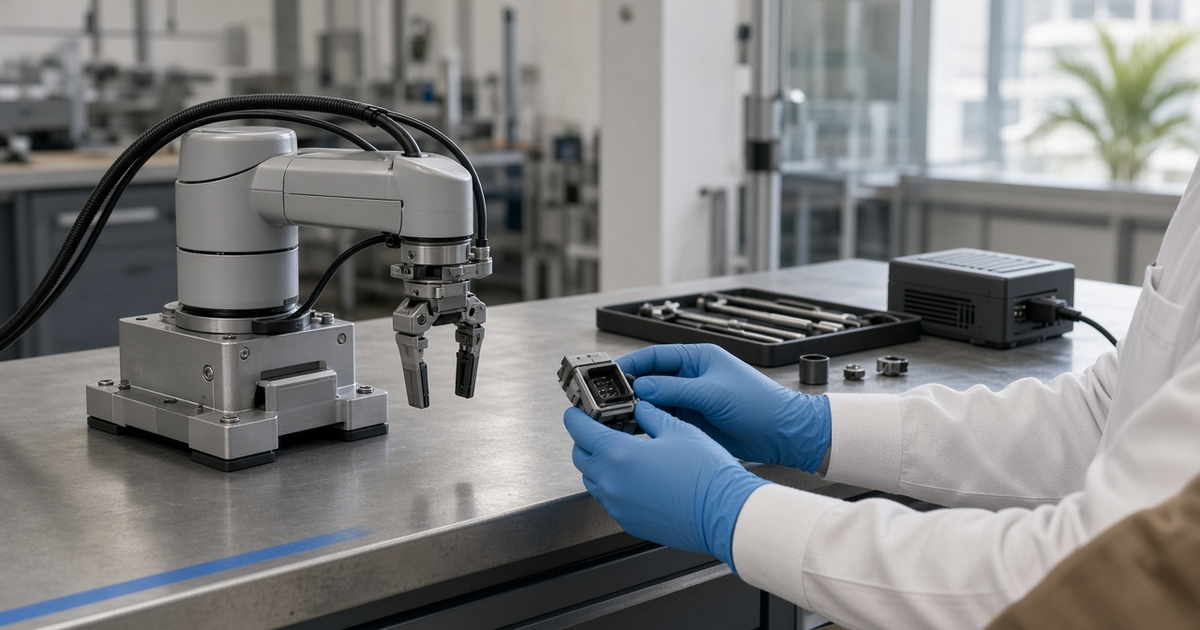
The News: A Possible Gulf Role in Physical AI
The National reported on October 14 that Chinese robotics companies were exploring Gulf partnerships. LinkerBot executive Weber Su described discussions with UAE institutions and a possible model combining Chinese components with capital-intensive assembly and production in the Gulf.
This is a report of exploratory discussions. It does not establish a completed investment agreement, an operating UAE factory or orders available to local suppliers.
LinkerBot’s own company information describes a business centred on dexterous robotic hands and related embodied-AI hardware and software. That supports a narrower view of robotics than the image of one humanoid doing every job. Components, control systems and applications can involve different companies and skills.
For this article, physical AI means AI systems connected to machines that act in the physical world. It is a useful category for examining opportunities, not proof that any specific machine is ready for unrestricted autonomous work.
The Customer Is Buying a Working Task
Imagine a manufacturer considering automation for a particular handling task. This is a hypothetical example, not a reported LinkerBot deployment.
A machine may demonstrate the movement. The customer still needs it to work with the items, layout, production schedule and safety conditions at that site. The result must be acceptable, and staff need a response when it is not.
That creates several possible commercial roles. A component supplier may sell hardware. An integrator may configure a system around the task. A local service business may provide authorised maintenance. A training provider may help employees operate and supervise it.
Each role has a different payer and deliverable. The manufacturer might pay an integrator for an accepted installation, then pay a service provider for defined support. Neither payment should be assumed until the customer’s need, procurement route and contract are known.
The business question becomes specific: which task is costly enough to improve, and which part can you deliver better than the customer’s current alternative?
Three Routes into the Industry Carry Different Risks
Selling or Distributing Equipment
A distributor could earn a margin on equipment sales. To make that a viable business, it would need actual supplier terms and enough paying customers after freight, storage, demonstration, sales and warranty-handling costs.
An impressive product does not settle territorial rights, returns, spare-parts availability or who pays when installation is delayed. Those are contract questions.
Buying inventory before customer demand is demonstrated commits capital to a particular product. A different model or supplier could become more appropriate before the stock is sold.
Integrating a Defined Application
An integrator could earn project revenue by making equipment fit a specific workflow. The customer would need agreed acceptance criteria: which task, which conditions, what output and how exceptions are handled.
The margin depends on the work after the sale as well as the quoted project price. Site changes, software adjustments, repeat visits and unresolved acceptance can absorb the expected return.
A tightly defined assignment may therefore be more manageable than an open promise to “automate the site.” Relevant competence, safety responsibilities and access to the underlying technology must be established first.
Supporting Equipment Already in Use
Maintenance and operational support could produce recurring revenue. But a recurring invoice is valuable only if the service can be delivered at a sustainable cost.
The provider needs a real installed base, authority and competence to service the equipment, access to parts and documentation, and clear escalation to the manufacturer. None is established merely by local interest in robotics.
Customers may also expect response times that require technicians, travel or spare stock before a large customer base exists. The cost of being available is part of the business model.
A Hypothetical Service Business Can Look Healthy Before Its Costs Are Counted
Consider a small provider with 10 signed customers paying AED 2,000 each per month. These are illustrative assumptions, not market prices, verified demand or a forecast.
Monthly recurring revenue would be:
10 × 2,000 = AED 20,000.
Assume direct monthly technician and travel costs of AED 11,000, plus AED 4,000 allocated to tools, administration and cover for availability. That leaves AED 5,000 before tax, financing, owner distributions and any costs not included in these assumptions.
Now assume one difficult month requires AED 7,000 of additional specialist support and parts that the provider must pay for and cannot recover from the customer or manufacturer.
20,000 − 11,000 − 4,000 − 7,000 = −AED 2,000.
The purpose is to examine responsibility, not predict repair frequency. If the manufacturer bears that cost, if the customer approves a separate charge, or if the service scope excludes it, the provider’s result changes. Those arrangements need to exist in the contract rather than in the sales forecast.
Customer count also matters. Ten interested businesses are not ten signed customers. Even signed revenue may arrive later than payroll and supplier payments; the calculation above is an operating result comparison, not a cash-timing forecast.
Local Assembly and Local Value Are Separate Questions
A Gulf assembly operation could create activity and capabilities. The amount of value retained locally would depend on what work is actually done and under whose control.
Relevant questions include ownership of designs and software, procurement of imported components, training, testing, warranty responsibility and the customers the operation is allowed to serve.
If a local operation mainly assembles imported kits under narrow instructions, its economics differ from a business that can adapt designs, improve processes and support customers independently. Neither arrangement is automatically poor; the required capital and expected margin must match the role.
For a prospective supplier, a factory announcement is therefore the start of research. The next evidence would be an operating timeline, real procurement requirements, qualification standards and a funded customer programme.
For an investor, regional spending and technological usefulness do not establish the price at which a particular company becomes attractive. Revenue rights, costs, capital requirements and valuation remain separate tests.
What This Could Mean for Technical Workers
The relevant work may extend beyond designing the entire robot. A deployment could require application understanding, mechanical and electrical troubleshooting, software integration, testing, documentation and customer training.
These are role hypotheses, not verified vacancies or a promise of salary growth. The useful next step is to compare actual employers’ requirements and local training pathways with the work a person can demonstrate.
Someone with maintenance experience may have a different entry route from a software developer. Both would need to identify the limits of their competence and the additional training or authorisation required. Safety-critical work should not be treated as a short online-course opportunity.
For a worker considering an expensive qualification, ask which real roles it prepares them for and what evidence employers accept. For a small firm, ask whether the required skill can be acquired before taking contractual responsibility.
Three Conditional Paths to Watch Over the Next Year
The following are hypothetical paths for a prospective Gulf supplier’s next 12 months, not predictions about LinkerBot or any named company.
Partnership interest remains exploratory. If there is no funded project, identified buyer or procurement process, focus on learning and customer discovery. Large stock purchases or a dedicated facility would be commitments ahead of demand. A signed, funded project would change the evidence.
A limited number of paid deployments begins. If customers have specific tasks and authorised suppliers, a focused integration or support role might become testable. Watch acceptance criteria, payment milestones, parts access and who carries rework costs. A successful demonstration without a buyer would not confirm this path.
Deployments grow into a serviceable installed base. If compatible systems are operating, support demand is recurring and contracts can cover the cost of availability, a local service model could become more plausible. A scattered customer base or heavy reliance on unrecoverable specialist help could weaken it.
These paths involve different capital commitments. The sensible amount to invest changes as the evidence changes.
A Customer Test Before a Capital Commitment
Before buying demonstration stock, hiring a team or committing to premises, write down five answers:
- Which named type of customer has a task worth paying to improve?
- What measurable deliverable would that customer accept and pay for?
- What supplier access, qualifications and permissions are needed?
- Which installation, warranty, support and failure costs would you carry?
- What paid evidence would justify the next investment, and what result would make you stop?
Where the scope and permissions allow, a small paid assessment or clearly bounded trial may answer some of these questions. It should not be presented as proof of broad demand, and it must not bypass technical or safety requirements.
An unanswered question belongs in the investment decision. It should not disappear into a large estimate of the future robotics market.
Follow the Work, Then Follow the Money
The Gulf’s possible role in robotics extends beyond buying impressive machines. Manufacturing, integration and support could each create value, but their economics are different.
For an entrepreneur, the starting point is a customer’s paid problem and a role the business can deliver responsibly. For a worker, it is a demonstrable capability connected to actual employer demand. For an investor, it is evidence of value capture after capital and operating costs.
There is room to be optimistic about the robot economy without paying for every possibility in advance. Commit more when customers, contracts and operating evidence make the opportunity more specific.
Educational analysis only. The business models and numerical example are hypothetical. No contract, job, technical authorisation or investment return is promised.
Sources
- Salim A. Essaid, “Chinese companies seek Gulf partnerships as physical AI takes shape,” The National, 14 October 2026; accessed 19 October 2026.
- LinkerBot, official company information, “About Us,” accessed 19 October 2026. Manufacturer description of its business; not independent validation of product performance or Gulf deployment.

