Four minutes tells you how quickly a meal can be prepared. It leaves an owner with a harder question: will enough people pay for that meal again?
AUDIO INSIGHT BRIEFING
Listen to the key implications in under three minutes (2:04).
READ THE FULL ANALYSIS BELOW ↓
Why This Matters
The arrival of robotic cooking in an Abu Dhabi food outlet offers a concrete way to examine automation as an investment. A demonstration can show that a machine works. A business needs evidence that its menu, location and operating costs work together.
For a small operator, the risk is committing capital before establishing paying demand. For an employee, the question is which responsibilities remain around the machine. For someone building an AI transformation service, the opportunity may be helping a business make those decisions and manage the workflow—not necessarily selling it a robot.
Key Points
- Production capacity and paid orders are different numbers.
- Standardised cooking can be suitable for automation; customer acceptance and repeat buying still require testing.
- Removing a cooking task does not remove every staffing or operating cost.
- Covering monthly costs and recovering the original investment are separate tests.
- A useful technology can still be a poor purchase at a particular site or price.
What the Abu Dhabi report establishes
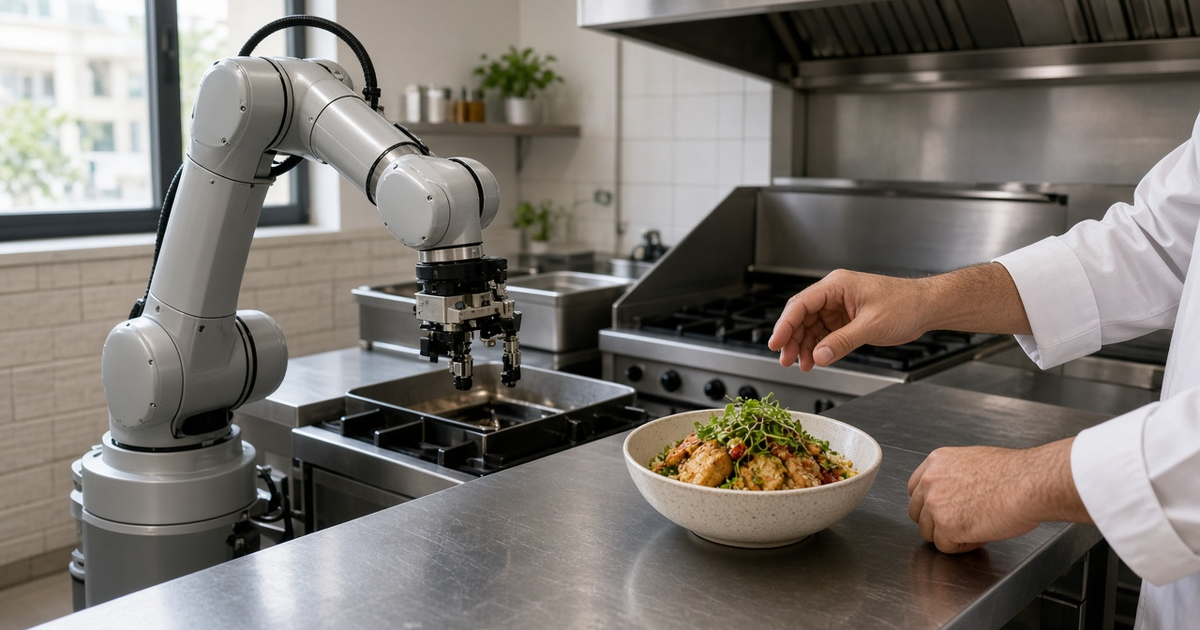
The National’s 13 October report describes Circus Group’s CA-1 at First Clique in Abu Dhabi, working with Royal Prestige. It reports meals prepared in about four minutes and a shareholder’s estimate of approximately AED 1 million for the machine. That figure is an attributed estimate, not a verified all-in purchase quotation. The report also describes human work remaining around ingredient loading, orders and service. [1]
This is recent field reporting, rather than a new launch today. Circus announced its UAE commercial operations on 22 September and scheduled a launch event for 6 October. Its stated expansion ambitions are company claims, not evidence of profitable demand at every proposed site. [2]
Neither source supplies audited profitability or a representative long-term customer-retention study for this installation. The following analysis therefore uses explicitly hypothetical business conditions, not claimed results from CA-1.
Start with the meal customers want
It is tempting to classify robotic food as suitable for convenience meals and too early for restaurants built around taste. That is a useful question to investigate, but it is too broad as a conclusion. Automation alone cannot establish whether food tastes good or bad.
The more useful distinction is between a repeatable process and work that requires frequent adjustment. A limited menu with controlled ingredients, portions and cooking steps is a plausible starting point for automation. This can include freshly cooked food; it does not have to mean packaged instant food.
A menu that depends on adjusting to variable ingredients, delicate texture, customer requests or individual finishing creates more conditions to test. Whether a particular system can handle them needs menu-specific evidence.
A convenience site might attract buyers because a reliable hot meal is available during a late shift. A restaurant whose customers return for a distinctive flavour and attentive service has a different commercial promise. Both need acceptable taste, but they may compete on different combinations of availability, quality, price and experience.
For a taste-led restaurant, full automation may be premature if the operator cannot demonstrate that those valued characteristics survive. Partial automation is another option: remove a repeatable task while retaining human control over the distinctive cooking and final quality judgment. Compare this with the current kitchen before assuming a whole-system replacement is necessary.
A first purchase can measure curiosity
A new machine may attract customers who want to try something unusual. Their purchase establishes an initial sale. It does not establish routine demand after the novelty fades.
A proposed pilot should separate first-time visits from repeat paid purchases where this can be measured with appropriate consent. Also record price paid, discounts, refunds, remakes, rejected menu options and the time of day. Do not count complimentary tasting portions as paid demand.
A customer survey can help explain an outcome, but stated willingness to return is weaker evidence than a subsequent purchase. Compare like-for-like offers and disclose promotions when judging repeat behaviour.
The business question is whether customers continue to choose the meal at a price that supports the operation. A high satisfaction score cannot compensate for a price customers will only pay once.
Count the work around the robot
Map the complete operation before forecasting savings: ingredient procurement and preparation, replenishment, cleaning, quality checks, customer assistance, waste handling, equipment service and downtime response.
Some costs vary with meals sold. Others remain even during a quiet shift. The way a supplier bundles software, maintenance and support also changes the investment case.
Staff capacity recovered becomes a cash saving only when an actual expense changes. The existing team may instead use that time for service, additional output or a safer workload. Those can be valuable results, but they should be measured and named correctly.
Request the actual installation scope, consumables, service response, spare-parts arrangements, permitted menu changes and ongoing fees. Check applicable food-safety, premises and employment requirements with the relevant authorities and advisers. A machine’s approval does not by itself resolve all obligations at an operating location.
How many orders would a hypothetical site need?
The figures below are illustrative assumptions for a new, separately evaluated site. They are not CA-1 costs, a supplier quote, observed sales or a forecast. They are expressed in AED and assume 30 operating days per month.
Assume:
- Net revenue per paid meal: AED 40, after excluding tax collected for authorities.
- Variable cost per meal: AED 22, including the assumed per-meal food, packaging, transaction/channel charges, energy and waste allowance.
- Contribution per meal: AED 18, calculated as 40 minus 22.
- Monthly cash operating fixed costs: AED 24,000, including the assumed remaining staff, site costs, software, scheduled support and cleaning costs not already counted per meal.
- Initial investment: AED 1 million, used solely as a round hypothetical input. An actual project would need its own full installation and working-capital budget.
First, calculate operating break-even:
AED 24,000 ÷ AED 18 = approximately 1,334 paid meals per month.
That is roughly 45 paid meals a day when rounding up for a 30-day month. At this level, the model covers the listed monthly operating cash costs. It has not recovered the original investment.
Now introduce a chosen capital-recovery target of five years. This is a test condition, not an expected equipment lifetime or guaranteed payback.
AED 1 million ÷ 60 months = approximately AED 16,667 per month for capital recovery.
(AED 24,000 + AED 16,667) ÷ AED 18 = approximately 2,260 paid meals per month.
That corresponds to about 76 meals a day after rounding up. The target is materially higher than operating break-even.
This simplified model excludes financing costs, income taxes, the time value of money, major replacement expenditure and any residual value. It is a first screening calculation, not an accounting profit figure or full investment valuation. Include omitted items before making a real commitment.
There is another sensitivity worth seeing. If net revenue falls to AED 35 while variable costs stay at AED 22, contribution falls to AED 13. The same operating-cost and capital-recovery target requires approximately 3,129 paid meals a month, or about 105 a day when rounded up. A small price concession can change the required sales volume substantially.
These daily averages also conceal busy and quiet periods. A site must have enough customers during usable hours, with the menu, staffing and equipment available when those customers arrive.
Three scenarios that change the decision
The following are conditional scenarios, not likelihood estimates. They use the illustrative model above where stated. An initial pilot might run for 60–90 days, but seasonality, novelty and maintenance history require a longer view before inferring sustainable demand.
1. A new location supplies meals people already need
Assumptions: There is an identifiable unmet meal occasion, customers accept the menu and price, and the operation sustains 2,400 paid meals per month at the assumed AED 18 contribution.
Mechanism: The business captures paid demand rather than relying on demonstrated production capacity. Monthly contribution is AED 43,200; subtracting the assumed fixed costs leaves AED 19,200 before the omitted items described above. This exceeds the model’s AED 16,667 monthly capital-recovery target.
Decision: Investigate further rather than declare the investment profitable. Verify that sales persist without launch subsidies, all costs are included and the operating location remains available on acceptable terms.
Evidence that would weaken the case: Repeat sales fade, the net price falls, support costs rise or occupancy terms change. A crowd at launch does not resolve these questions.
2. The robot handles orders an existing kitchen already serves
Assumptions: Total paid demand is unchanged; customers receive a comparable offer; the machine replaces part of the current process.
Mechanism: Counting all robot-served revenue as new revenue would overstate the benefit. The comparison is against the current kitchen: actual expenses avoided, genuinely additional contribution earned, new operating expenses and any margin lost through reduced customer demand.
Decision: Evaluate a replacement or partial-automation case. Use the existing operation as the baseline; do not apply the new-site model as though the existing customers arrived because of the robot.
Evidence that would change the case: Measured new opening hours attract additional paid customers, an identifiable expense is removed, or staff capacity supports profitable additional service. Count each benefit once.
3. Taste, menu fit or reliability reduces paid demand
Assumptions: As a stress test, paid sales are 30% below the 2,400-meal level: 1,680 meals per month. Keep the other model inputs unchanged solely to isolate volume sensitivity. This percentage is an invented stress assumption, not observed retention or a forecast.
Mechanism: Contribution becomes AED 30,240, leaving AED 6,240 after the listed fixed costs. The operation can cover those operating costs while falling well short of the five-year capital-recovery target.
Decision: A business can appear operationally viable yet fail the owner's investment objective. Investigate why demand is weaker before spending more on expansion. If downtime also creates repair expenses or food loss, calculate those separately without double-counting the lost meals.
Evidence that would weaken this concern: Repeat purchases at the intended price, low remake/refund rates, reliable uptime and a menu customers choose without heavy discounts. The cause of lower sales must be measured; do not automatically blame robotic cooking.
Opportunities around the machine
Potential paid services include preparing and replenishing ingredients, adapting recipes, training site teams, maintaining equipment and analysing demand. These are business hypotheses with different customers and constraints.
An operator might pay for a replenishment service that meets agreed quality and delivery requirements. A caterer might pay for a menu-validation project before committing to an installation. A site owner might commission a demand study that distinguishes launch curiosity from routine sales.
For a small AX service business, a bounded diagnostic can be a more practical first offer than owning an expensive machine. Analyse the workflow, establish cost and sales baselines, test an agreed intervention and report the measured result. Automation may involve ordinary software, human process changes or equipment; AI should have a defined job and a checking cost.
None of these possibilities demonstrates market size or available contracts. Verify the payer, access to the site and data, equipment-supplier permissions, food-safety responsibilities, delivery costs and willingness to pay. A limited paid engagement with explicit acceptance criteria is a proposed validation step. It should not become a promise to guarantee the customer’s profit.
Employees may also need different capabilities: recipe testing, equipment supervision, quality control and exception handling. Whether those roles produce higher pay or more employment depends on actual employer demand and training, not the arrival of one installation.
What to ask before committing capital
Request evidence that connects the proposed menu to repeat paid demand at the intended price. Ask for the full delivered and installed cost, operating responsibilities and support terms. Compare complete workflows rather than one cooking task.
Then run two calculations: the orders needed to cover operating costs and the orders needed to meet a chosen investment-recovery target. Change price, contribution, volume and downtime assumptions. Identify which change would make the project unsuitable and whether the site contract lasts long enough to support the investment.
For a taste-led restaurant, protect the reason customers return. A narrowly defined automation step that preserves that reason may be a better investment than replacing the whole kitchen before customer acceptance is established.
The financial lesson also applies to investors considering the wider sector. A functioning robot, a commercial launch, paid demand, an operator’s return and a supplier’s profitable growth are separate pieces of evidence. None establishes that a listed share is attractively priced.
A robot’s ability to cook a dish is the first test. The business test is whether customers choose it again at a price and volume that support the full investment.
Educational analysis only. All business calculations and scenarios are hypothetical, not a purchase recommendation or a forecast of the reported installation’s performance. Requirements and costs vary by location, contract and operating model.
References
[1] Shireena Al Nowais, The National. “New robot that can prepare your meal in under four minutes arrives in Abu Dhabi.” 13 October 2026. Field report and attributed company comments. Accessed 14 October 2026.
[2] Circus SE. “Circus starts commercial operations in the United Arab Emirates – Partners with Royal Prestige Catering.” Issuer announcement distributed through EQS News, 22 September 2026. Accessed 14 October 2026. Commercial ambitions are company statements.

