A new connection can make a distant home practical. Compare the whole journey, the hours you need and the expenses that actually disappear before changing your housing or car plans.
AUDIO INSIGHT BRIEFING
Listen to the key implications in under three minutes (1:45).
READ THE FULL ANALYSIS BELOW ↓
Why This Matters
A home can look close to public transport on a map and still be difficult to use. The missing connection may be a long walk, an unreliable transfer or a journey that does not work when your shift ends.
Dubai’s new driverless-pod trial is an opportunity to ask a better question about future transport: which journeys could it make dependable enough to change a household’s choices? The answer could affect where people live and whether they need another car. Those benefits require a usable service, beyond a successful demonstration.
Key Points
- Compare the complete journey from your door to your destination, including access, waiting and transfers.
- Check the hours and conditions that matter to your household. A convenient daytime journey may leave an evening shift or school pickup unresolved.
- Driving less can reduce some expenses while leaving car ownership costs intact.
- Treat planned connections as possibilities until operating details and performance support a real decision.
What Dubai is testing
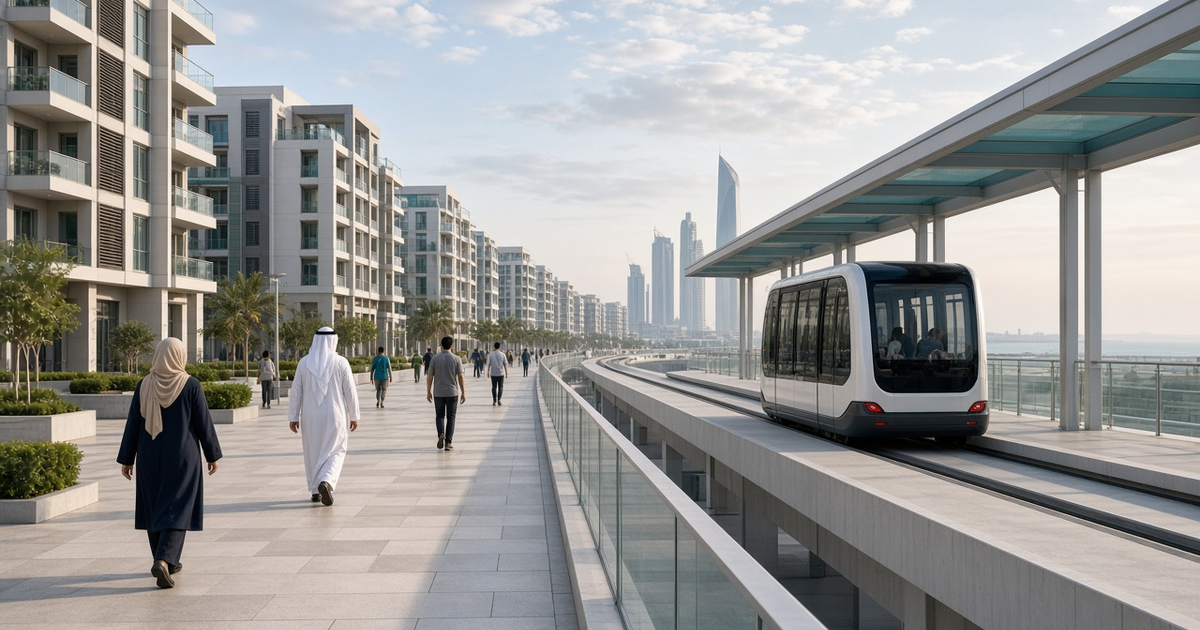
Reporting published on 11 October describes a four-week Glydways trial at Bluewaters. RTA is testing autonomous electric vehicles on dedicated guideways, including their operational performance and passenger experience. Integration with public transport and first- and last-mile connections are part of the intended role. [1, 2]
That gives the trial a practical purpose: assessing whether a new link can fit into everyday journeys. It does not establish a citywide service. This report has not verified public booking access, fares or an operating timetable for a regular commuter service. Proposed wider connections remain plans under study. [1, 2]
Households should therefore separate the system being tested, possible future routes and a journey they can actually use today.
A small connection can change the useful map
The useful map of a city consists of places you can reach when you need them. Distance alone does not describe it.
Suppose a station is reasonably close to an apartment, but reaching it requires an inconvenient connection. A dependable feeder service could make that apartment a realistic option for someone who previously needed to drive. The mechanism is a change in access to the wider network.
An employee might gain another housing option. A family might reconsider a second vehicle. A business near a station might become easier to visit. Each outcome depends on the actual connection, its price, availability and the rest of the journey. None is a measured result of the Bluewaters trial in this article.
The benefit can also be uneven. People with a straightforward commute may gain more than parents combining work, school and other stops. A link designed for one destination may offer little help to someone whose employer is elsewhere.
Compare two complete journeys
The following is an entirely hypothetical comparison for one employee travelling from home to an office. The figures are illustrative one-way minutes, not observed Dubai travel times, Glydways performance or a forecast.
Journey A: existing access to rail
- Walk to a feeder stop: 10 minutes.
- Wait: 12 minutes.
- Feeder ride: 10 minutes.
- Transfer and wait for rail: 8 minutes.
- Rail ride: 25 minutes.
- Walk to the office: 5 minutes.
Total: 70 minutes.
Journey B: assumed future connection
- Walk to its pickup point: 5 minutes.
- Wait: 4 minutes.
- Connection ride: 6 minutes.
- Transfer and wait for rail: 8 minutes.
- Rail ride: 25 minutes.
- Walk to the office: 5 minutes.
Total: 53 minutes.
Under these assumptions, the difference is 17 minutes each way. Across 20 working days with the same return journey, that is 680 minutes, or 11 hours and 20 minutes per month.
This is time recovered, with no automatic salary gain attached. Its value might be a less rushed pickup, more rest or another feasible place to live. Paid income increases only if an actual arrangement connects that time to paid work.
Now change one assumption: suppose the future connection’s wait is 20 minutes rather than four. Journey B becomes 69 minutes. The appealing vehicle has barely changed the total trip.
That is why waiting and transfers deserve as much attention as vehicle speed.
Two households can get different answers
Hypothetical situation: one regular commuter
An employee’s travel hours match an assumed feeder service. The office is within walking distance of rail, and occasional fallback transport is affordable. Over a proposed two-week observation period, the employee records departure time, arrival time, waiting and fallback spending. Two weeks is a suggested decision aid, not proof of long-term reliability.
If the connection works consistently, a home previously rejected for poor access may become worth comparing. Before moving, the employee still needs current service details, lease costs and a realistic view of disruption and special journeys.
Hypothetical situation: a family with several stops
One adult can use the same connection for work. The household still needs a vehicle for school runs, appointments or another adult’s shift. Driving falls, but the vehicle remains.
The family can count avoided fuel, parking and other genuinely avoided charges. It cannot claim the whole insurance bill or finance payment as a saving while continuing to pay it. Less driving and fewer cars are different financial outcomes.
Neither situation describes current access to the trial. They show the conditions a future service would need to satisfy.
Reliability matters at the awkward hour
A transport choice should work for the journey that constrains your day. That may be the earliest shift, the latest return or a connection before a fixed pickup time.
Keep a simple journey record: total minutes, longest wait, missed connections and actual fallback expenditure. Look at the trips that ran late as well as the average. Add any accessibility requirement that determines whether the journey is possible at all.
A demonstration can show that vehicles move successfully along a guideway. A household needs evidence about availability, transfers, access and useful operating hours. The published trial description does not resolve every one of those questions.
When better transport affects housing
Improved access could broaden the homes a commuter can consider. Whether that produces a saving depends on the housing comparison.
Compare rent and service charges, the complete transport bill and any actual costs of changing school runs or care arrangements. Keep travel time visible as time unless it changes a specific paid expense or income. Include moving costs if you are considering a move.
Future transport can also become part of a property’s sales pitch before a usable service exists. A proposed connection provides a reason to investigate. It cannot establish the opening date, everyday performance or resale return of an individual property.
For an investment judgment, distinguish a planned route, an operating connection, sustained usage and evidence that people will pay more for that access. This article does not establish the later stages.
The financial decision: count what stops being paid
Consider one final hypothetical monthly comparison. A household avoids AED300 of driving-related expenditure but pays AED180 for new transport and AED80 for fallback rides. Its net cash saving is AED40, not AED300. These amounts are assumptions, not published fares or market estimates.
The general calculation is: avoided expenditure minus new fares and fallback costs. A housing move adds its own costs and any change in rent. Count each expense once.
A new link could deliver substantial time or access benefits even when cash savings are small. Describe those benefits honestly. Before committing to a lease or disposing of a vehicle, establish which essential journeys the service covers and which bills it actually removes. That is the point where a transport innovation becomes a household decision.
References
1. ARN News Centre. “RTA launches trial of ‘Dubai Glydways’ autonomous electric transport system.” 11 October 2026. RTA announcement and four-week assessment programme.
2. Gulf Today / Emirates News Agency (WAM). “RTA launches trial operation of Dubai Glydways automated transit system at Bluewaters.” Updated 11 October 2026. Trial scope and future integration plans.
Educational analysis. The examples are hypothetical and are not individual transport, property or investment recommendations. Facts checked on 12 October 2026.

